


(Prayer: This Writ Appeal is filed under Section 4 of the Karnataka High Court Act praying to call for records in W.P.No.34041/2025 and set aside the order dated 01.12.2025, passed by the Learned Single Judge, by allowing the appeal.
This Writ Appeal is filed under Section 4 of the Karnataka High Court Act praying to set aside the order passed by the Learned Single Judge in Writ Petition No.34928/2025 dated 01/12/2025 and consequently allow this writ appeal.)
C.A.V. Judgment
Vibhu Bakhru, CJ.
1. The appellants, Rajiv Gandhi University of Health Sciences [University] and National Medical Commission [NMC], have preferred these appeals impugning the separate orders passed by the learned Single Judge in writ petitions (W.P.Nos.34041/2025, 34928/2025, 34487/2025 and 34621/2025 decided on 01.12.2025) which were preferred by the students of the University seeking re-evaluation of their answer scripts of the examination undertaken by them in subjects where they had failed to get the minimum marks for passing the said examination.
2. The criteria for passing the examination are to secure more than 200 marks out of 400 in the theory examination, which comprises four papers of 100 marks each, and a minimum of 40 marks in each of the four papers. The writ petitioners secured an aggregate of 200 or more marks, but failed to secure the minimum 40 marks in all papers. Thus, they were declared to have failed the examinations. In the aforesaid circumstances, they filed the said writ petitions, essentially, seeking re-evaluation of their answer scripts.
3. Under Regulation 8.4 of the Post-Graduate Medical Education Regulations, 2023 [The Regulations], each answer script was evaluated by two evaluators, and the average of the marks awarded by the two evaluators was accepted as the final result.
4. The learned Single Judge allowed the writ petitions and directed the University to refer the answer scripts of the subjects in question to a third evaluator with a further direction to take the average of the best of the two total marks awarded by the three evaluators, rounded off to the nearest integer (whole number) for the purpose of final computation of the results.
5. At the outset, it is material to note that there was no demonstrable error in the evaluation of the answer scripts. The only ground on which the writ petitions were allowed was that the aggregate marks secured by the writ petitioners were 200 or more, which was sufficient for them to pass the examination. However, they had been declared failed for failing to obtain the minimum threshold of 40 marks in one of the papers. The Court reasoned that the said fact warranted reference of the answer scripts to a third evaluator to "do substantial justice and on the grounds of equity".
6. The material facts regarding the marks secured by students in each of the writ petitions differ, and so do the results. The examinations and the course being undertaken by them vary; however, the question involved in the writ petition is common. The operative part of the impugned orders and reasoning of the learned Single Judge in allowing the respective writ petitions are similar. In this view, we consider it apposite to dispose of the present appeals by a common judgment.
7. A tabular statement setting out the writ petition number, name of the writ petitioner, the course, the aggregate marks as obtained and the examination paper wherein the marks awarded are less than 40, the marks awarded by the two evaluators and the average marks in the said paper are set out in the table below.
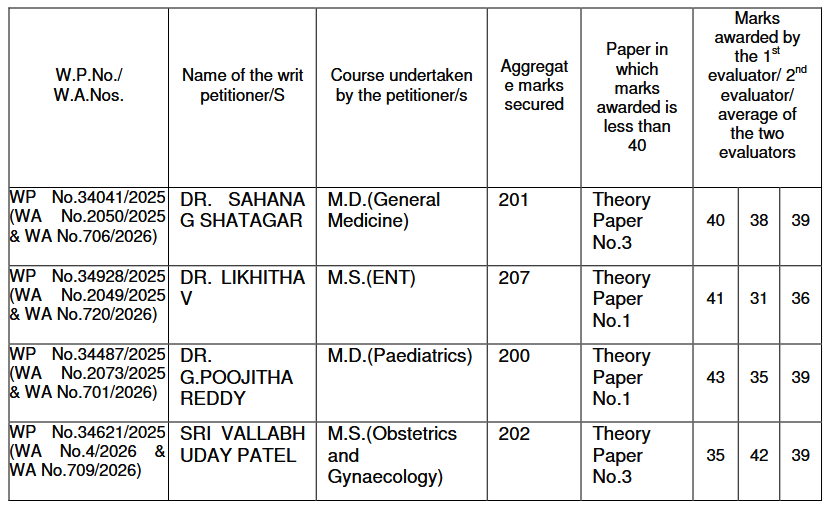
8. For the purposes of anchoring the present decision on a factual matrix, we consider it apposite to treat W.A.No.2050/2025 (EDN-RES) as the lead matter.
9. The writ petitioner (respondent No.1) is a student undergoing the course of M.D. (General Medicine) in the University. She appeared in an examination conducted in September 2025, and secured an aggregate of 201 marks out of a maximum of 400 marks in the four theory papers. Whereas the marks obtained by her in theory papers I, II, and IV were above 40 out of 100, the marks obtained by her in paper III were 39. This was because one of the evaluators awarded 38 marks, while the other evaluator awarded 40 marks for the answer script. The average of the marks awarded by the two evaluators is taken for the final result. Thus, the writ petitioner's marks in paper III were determined as 39 marks for the purposes of determining her final result. Since the said marks were below the minimum required to clear the examination, the writ petitioner was declared as failed. In the aforesaid circumstances, she filed the writ petition being W.P.No.34041/2025 (EDN-RES), inter alia, praying as under:
"i. Issue a Writ of Mandamus or any other appropriate writ, order, or direction directing the Respondent-University to conduct an additional evaluation of the Petitioner's Answer Paper III of the subject M.D. General Medicine of the P.G Medical Examination of September 2025, by appointing two new examiners other than those who evaluated earlier, in accordance with its regulations and to declare the result based on the additional evaluation; and
ii. Direct the Respondent-University to publish the revised result of the Petitioner expeditiously, within a time frame fixed by this Hon'ble Court, in the interests of justice and equity; and
iii. Declare that the Registrar (Evaluation), being a statutory authority under the RGUHS Act, possesses the power and is under a duty to exercise such discretion in cases involving apparent evaluation errors or exceptional hardship, and that his refusal to do so in the present case amounts to non-exercise of jurisdiction and arbitrary inaction; and
iv. To direct the Registrar (Evaluation), RGUHS, to exercise the discretion vested in him to order re- evaluation or additional evaluation in exceptional cases of manifest error, including that of the Petitioner herein, in accordance with the principles of fairness, equity, and uniformity; and
v. Grant such other reliefs as this Hon'ble Court may deem fit in the circumstances of the case."
10. The said petition was allowed by an order dated 01.12.2025. The operative part of the order reads as under:
"ORDER
i) The Writ Petition is hereby allowed.
ii) Respondent No.1-Rajiv Gandhi University of Health Sciences, Jayanagar, Bengaluru is directed to refer Theory Paper No.3 written by the petitioner to a third Evaluator and announce the result, in terms of Regulation 8.4(b) of the Post Graduate Medical Education Regulations, 2023 within a period of three weeks from the date of receipt of a copy of this order."
11. Before proceeding further, it would be relevant to refer to the Regulations that govern the evaluation of the answer scripts. Regulation 8.4 of the Regulations is relevant, and the relevant extract is set out below.
"8.4 Valuation:
a. All the teachers of the other colleges of the concerned University or other Universities, who are eligible to be post-graduate examiners, can perform the valuation of the answer scripts.
b. All the answer scripts shall be subjected for two valuations by the concerned University. The average of the total marks awarded by the two valuators for the paper, which is rounded off to the nearest integer (whole number), shall be considered for computation of the results. All the answer scripts, where the difference between two valuations is 15% and more of the total marks prescribed for the paper shall be subjected to third valuation. The average of the best two total marks, awarded by the three evaluators for the paper, rounded off to the nearest integer (whole number), shall be considered for final computation of the results.
c. After the computation and declaration of the results, under no circumstances, revaluation is permitted.
d. All the Health Universities/Institutions imparting post-graduate courses shall implement digital valuation.
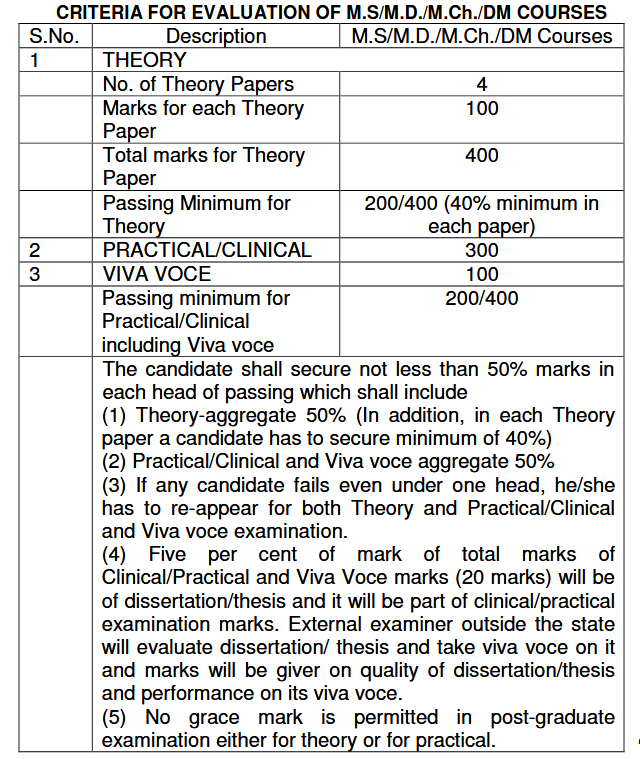
12. Regulation 8.4(c) of the Regulations expressly prohibits re- evaluation of the answer scripts. Regulation 8.4(b) provides that the answer scripts shall be subjected to two evaluations, and the average of the total marks awarded by the two evaluators for the paper, rounded off to the nearest integer (whole number), would be considered for the computation of the results. There is no ambiguity in the method used to calculate the results.
13. The question of whether students/candidates are entitled to re-evaluation of answer scripts where the applicable rules and regulations prohibit the same is no longer res integra. In Maharashtra State Board of Secondary and Higher Secondary Education and Another v. Paritosh Bhupeshkumar Sheth and Others (1984) 4 SCC 27, the Supreme Court considered an appeal from a High Court decision striking down a rule prohibiting the re-evaluation of answer books. The said rule had been challenged by certain students, inter alia, praying that they be allowed to inspect the answer sheets and the Board (Maharashtra State Board of Secondary and Higher Secondary Education) be directed to re- evaluate the answer scripts. The Bombay High Court had partly allowed the writ petition. In the aforesaid context, the Supreme Court held as under:
"20. We consider that the above approach made by the High Court is totally fallacious and is vitiated by its failure to follow the well-established doctrine of interpretation that the provisions contained in a statutory enactment or in rules/regulations framed thereunder have to be so construed as to be in harmony with each other and that where under a specific section or rule a particular subject has received special treatment, such special provision will exclude the applicability of any general provision which might otherwise cover the said topic. Regulation 102(2), if properly construed in the setting in which it occurs, only confers a suo motu power on the Divisional Board to amend the result of the examination in respect of any candidate or candidates on its being found that such result has been affected by error, malpractice, fraud, improper conduct, etc. The "error" referred to in the said provision has, in the context, to be understood as being limited to an error arising in consequence of malpractice, fraud, improper conduct or other similar matter of whatsoever nature. We are unable to understand this provision as conferring any right on an examinee to demand a disclosure, inspection or verification of his answer books or other related documents. All scope for doubt or speculation in relation to this matter has, however, been eliminated by the provision contained in Regulation 104 which specifically deals with the subject of verification of marks obtained by a candidate. Clause (1) of the said regulation states that any candidate who has appeared at the HSC examination may apply to Divisional Secretary for verification of marks, particularly in any subject, but such verification will be restricted to check whether all the answers have been examined and whether any mistake has been committed in totalling of marks in that subject or in transferring marks correctly on the first cover page of the answer book as well as whether the supplements attached to the answer books as mentioned by the candidates are intact. Clause (3) of the said regulation imposes the further limitation that no candidate shall claim or be entitled to revaluation of his answer book or disclosure or inspection of the answer book or further documents as these are to be treated by the Divisional Boards as most confidential. It is obvious that clauses (1) and (3) have to be read together and not in isolation from each other as has apparently been done by the High Court. The right of verification conferred by clause (1) is subject to the limitation contained in the same clause that no revaluation of the answer books or supplements shall be done and the further restriction imposed by clause (3), prohibiting disclosure or inspection of the answer books. The High Court seems to have construed the last portion of clause (3) as implying that the confidentiality of the answer books is to be declared by some order of the Divisional Board and it has proceeded to hold that since no such order was brought to the notice of the Court there was no basis for treating the answer books as confidential. In our opinion, this interpretation of the concluding words of clause (3) is incorrect. What is laid down therein is that the answer books and other documents are to be treated by the Divisional Boards as most confidential. In other words, this clause of the regulation contains a mandate to the Divisional Boards to treat the answer books and documents as confidential and lays down that no candidate shall be entitled to claim disclosure or inspection of the said confidential books and documents. We are also of the opinion that the High Court was in error in invoking the "doctrine of implied power and obligation" for the purpose of holding that because the right of verification has been conferred by clause (1) of Regulation 104, there is an implied power in the examinees to demand disclosure and inspection and a corresponding implied obligation on the part of the Board to accede to such a demand. There is no scope at all for invoking any such implied power or imputing to the regulation-making authority an intention to confer such power by implication when there is an express provision contained in the very same regulation [clause (3)] which clearly manifests the contrary intention and states in categorical terms that there shall be no claim or entitlement for disclosure or inspection of the answer books."
14. In a later decision in the case of Pramod Kumar Srivastava v. Chairman, Bihar Public Service Commission, Patna and others (2004)6 SCC 714, the Supreme Court referred to the decision in the case of Maharashtra State Board of Secondary and Higher Secondary Education v. Paritosh Bhupeshkumar Sheth (supra) and held as under:
"..in the absence of any provision for re-evaluation of answer-books in the relevant rules, no candidate in an examination has got any right whatsoever to claim or ask for re-evaluation of his marks..".
15. The Supreme Court reiterated the said principle in Board of Secondary Education v. Pravas Ranjan Panda and another (2004)13 SCC 383; Himachal Pradesh Public Service Commission v. Mukesh Thakur and another (2010) 6 SCC 759; and Central Board of Secondary Education and others v. Khushboo Shrivastava and others (2014)14 SCC 523.
16. We may also refer to the observations of the Supreme Court in Ran Vijay Singh and others v. State of Uttar Pradesh and others (2018) 2 SCC 357. In this case, the Supreme Court carved out an exception and held it as an exception to the general rule that a re-evaluation is not permitted if the relevant rules or regulations do not provide for the same. The Court observed as under:
"30.2 If a statute, Rule or Regulation governing an examination does not permit re-evaluation or scrutiny of an answer sheet (as distinct from prohibiting it) then the court may permit re-evaluation or scrutiny if it is demonstrated very clearly, without any "inferential process of reasoning or by a process of rationalization" and only in rare or exceptional cases that a material error has been committed;
** ** ** ** **
30.5 In the event of a doubt, the benefit should go to the examination authority rather than to the candidate."
17. It is relevant to note that in the present case there is no allegation of any malpractice, non-evaluation of answers, procedural irregularity or lack of competence on the part of the examiners. However, the petitioners contended that the re-evaluation of the answer scripts is warranted in exceptional circumstances where they had secured an aggregate of 50% overall marks in the theory papers, but were declared failed on account of their marks in one paper falling short of the threshold of 40 marks. The writ petitioners contend that in these peculiar circumstances, grave injustice would be caused if their answer sheets are not re-assessed.
18. We find little merit in the aforesaid contention. The criteria for clearing an examination are well defined. Regulation 8.4 clearly stipulates that the student must meet the twin conditions to pass the examination. First, the aggregate marks in all theory papers are required to be 200 out of 400 or above. And second, the student must secure at least 40 marks in each paper.
19. The fact that the students have secured more than 200 out of 400 marks in aggregate but have failed to clear one or more theory papers is not an exceptional circumstance that would warrant any interference by this Court under Article 226 of the Constitution of India.
20. The criteria that a student must secure a minimum 50% aggregate mark in all papers and secure a minimum threshold pass mark in each paper are neither novel nor unusual. It would be impermissible for the Court to direct re-evaluation of answer scripts solely because a student has not secured the minimum marks required for clearing an examination.
21. The learned single judge directed the re-evaluation of the papers, as the court felt it was equitable and necessary for substantial justice. We are unable to concur with the said view. There is no allegation that the evaluation is biased or that the evaluators were incompetent to assess the papers. In the circumstances, absent any manifest error in the evaluation of answer scripts or the evaluation process, there is no justification - either on the ground of equity or law - to interfere with the examination results. Furthermore, such a direction to refer the answer scripts for re-evaluation is expressly prohibited under Regulation 8.4(c) of the Regulations.
22. In Dr. NTR University of Health Sciences v. Dr. Yerra Thrinadh and others (2022) 18 SCC 716, the Supreme Court referred to the decision in the case of Ran Vijay Singh (supra) and had observed that:
"As observed and held by this Court in Ran Vijay Singh that sympathy or compassion does not play any role in the matter of directing or not directing re-evaluation of an answer sheet".
23. There is yet another contention advanced on behalf of the writ petitioners, which requires consideration.
24. It was contented that Regulation 8.4(b) also contemplates that the answer scripts be subjected to a third evaluation if the difference between the two evaluators is 15% or more of the total marks prescribed for the paper.
25. The learned counsel for the writ petitioners submitted that the variation of 15% in the marks awarded by the two evaluators ought to be the difference in the marks awarded as a percentage of the average marks awarded by the two evaluators and not the maximum marks for the paper in question.
26. It is apparent that the provision for referring the answer scripts to a third evaluator when the difference in valuations is large is to mitigate any inherent bias or arbitrariness in the subjective evaluation. Thus, the University has set the minimum variation as 15% of the total marks prescribed to trigger a reference to the third evaluator. There is little doubt that the object of the regulation is to make a reference to a third evaluator when variation in marks by the two evaluators is large. The said object would be better served if the measure of the difference between the two evaluations is the percentage of the marks awarded, rather than the percentage of the maximum prescribed marks. In cases where the marks awarded are relatively low, the minimum variation of 15% of the maximum marks prescribed would be satisfied only if the variation is significantly larger than in cases where the marks awarded by the evaluators are higher. Since the maximum marks prescribed for all theory papers is 100; 15% of the total marks prescribed for the paper would be 15. The reference to the third evaluator would be made only if the variation between evaluations exceeds 15 marks. This variation in absolute terms is significantly higher in percentage terms of the marks actually awarded, if the marks awarded are relatively low. Illustratively, if one examiner evaluates the answer script and awards 10 marks, while the other awards 24, the variation in the marks calculated in reference to the marks awarded is huge, it is 140% of the marks awarded by the evaluator awarding 10 marks and 58.3% of the marks awarded by the evaluator awarding 24 marks. Despite the said huge variation, where the marks awarded by the second evaluator is 240% of the marks awarded by the first evaluator, reference would not be made to a third evaluator. This variation of 15 marks, would progressively decrease in percentage terms where the marks awarded by the evaluators is higher. Illustratively, if the first evaluator awards 80 marks and the second evaluator awards 95 marks, the variation is merely 18.75% of the marks awarded by the first evaluator and 15.78% of the marks awarded by the second evaluator. This variation is significantly lower in percentage terms than in a case where the first evaluator has awarded 10 marks and the second evaluator has awarded 24 marks. Nonetheless, a reference would be made to the third evaluator in the case of 80 and 95 marks, and not in the case of 10 and 24 marks.
27. In our view, it would perhaps have served the object better if the minimum variation had not been pegged to the total marks prescribed for the paper, but to the marks as awarded by the examiners. However, this is a matter for the authorities framing the regulations to consider.
28. Since there is no ambiguity in the plain language of Regulation 8.4(b) of the Regulations, we are unable to interpret the said regulation to require reference to a third evaluator where the variation in the marks awarded is less than 15. The expression "total marks prescribed for the paper" cannot be construed to mean anything other than the maximum marks for the paper; that is 100 marks.
29. In view of the above, the appeals are allowed, and the impugned orders are set aside.
30. Pending applications, if any, shall also stand disposed of.

 |
This Product is Licensed to , |