


(Prayer: This Writ Petition is filed under Articles 226 and 227 of the Constitution of India praying to i) issue a writ of mandamus or any other appropriate order to the respondents to consider the representation vide Annexure-F, dated 10.12.2025 of the petitioner in a time bound Manner, in the interest of justice and equity; ii) issue a writ of mandamus, directing the Respondent No.1-State of Karnataka, Department of Labour and Respondent No.2 Deputy Labour Commissioner, Belagavi, to implement and enforce the Govt.Order bearing No.Ld466let2023 dated 20.11.2025 vide Annexure-D and Government notification published in the Karnataka Gazettee Extra Ordinary Part 1, No.748/Kae466 let 2023 dated 12.11.2025 introducing the Menstrual Leave Policy, vide Annexure-D1, dated 20.11.2025, Across All Establishments Within The Jurisdiction Of Belagavi District, including Hotels and Small Commercial Untis, in the interest of equity and justice; iii) issue a writ of mandamus any other appropriate writ or order directing the respondents to frame and issue appropriate guidelines, circulars or instructions to secure uniform implementation and execution of the policy, Particularly in the Unorganised Labour Sector where women Workers such as the petitioner are most vulnerable, in the interest of justice and equity.)
CAV Order
1. The petitioner, a woman of modest means who asserts that she has toiled as a labourer for several years, now stands before the doors of this Hon'ble Court, invoking its extraordinary jurisdiction, seeking the complete and meaningful implementation of the policy of the State Government as enunciated on 12-11-2025 and subsequently crystallized through Government Orders dated 20-11-2025 and 02-12-2025.
2. Facts, in brief, germane are as follows: -
2.1. The petitioner is stated to be employed in a small, local hotel, where her daily existence is marked by relentless physical exertion. Her duties, as narrated, encompass cleaning, washing of utensils, serving of food, and the performance of assorted menial tasks that demand sustained bodily labour from the early hours of the morning until late into the evening.
2.2. The environment in which she is constrained to work is described as not only physically taxing, but also bereft of adequate standards of hygiene and dignity. Such conditions, it is urged, bear with particular severity upon women workers, and more so during the period of menstruation, when the natural physiological processes of the body are accompanied by discomfort, fatigue, and pain, thereby rendering the performance of such arduous tasks exceedingly burdensome.
2.3. It is further averred that the State of Karnataka, conscious of these lived realities and the need to secure dignity and equity in the workplace, initiated, in the year 2024, a progressive step towards the formulation of a Menstrual Leave Policy by constituting a dedicated committee to examine the issue in its multifaceted dimensions. The Committee, in its deliberative wisdom, invited objections, suggestions, and inputs from a wide spectrum of stakeholders, including subject-matter experts, representatives of hotel associations, labour unions, and women's organizations, among others.
2.4. The consultative process, as submitted, witnessed an overwhelming response, with a significant number of stakeholders expressing support for the introduction of a structured policy recognizing menstrual leave as a facet of workplace justice and gender equity. It is, therefore, the petitioner is before this Court seeking the following prayer:
"(i) Issue a Writ of Mandamus or any other appropriate order, to the Respondents to consider the Representation vide Annexure-F dated 10-12-2025 of the Petitioner in a time bound manner, in the interest of justice and equity.
(ii) Issue a Writ of Mandamus, directing the Respondent No.1 - State of Karnataka, Department of Labour and Respondent No.2 - Deputy Labour Commissioner, Belagavi District to implement and enforce the Government Order Bearing LD 466 LET 2023 dated 20- 11-2025 vide Annexure-D and Government Notification published in the Karnataka Gazette Extraordinary Part-1 No.748/ KaE 466 LET 2023 dated 12-11-2025 introducing the Menstrual Leave Policy, vide Annexure-D1 dated 20- 11-2025, across all establishments within the jurisdiction of Belagavi District, including hotels and small commercial units in the interest of equity and justice.
(iii) Issue a writ of mandamus, any other appropriate writ or order directing the Respondents to frame and issue appropriate guidelines, circulars or instructions to secure uniform implementation and execution of the policy, particularly in the unorganized labour sector where women workers such as the petitioner are most vulnerable, in the interest of justice and equity."
3. Heard Ms. Deeksha N. Amruthesh, learned counsel appearing for the petitioner and Smt. Prathima Honnapura, learned Additional Advocate General appearing for the respondents.
SUBMISSIONS:
PETITIONER:
4.1. Learned counsel Ms. Deeksha N Amruthesh, appearing for the petitioner, would, with considerable vehemence and conviction, contend that the recognition of menstrual leave for women workers and employees has now transcended mere discourse and has culminated in the formulation of a legislative Bill. The same, it is urged, constitutes a beneficial and progressive piece of legislation, intended to advance the cause of gender equity and workplace dignity.
4.2. It is her emphatic submission that such a salutary measure ought not to be rendered illusory or stifled at its nascent stage by inaction or indifference on the part of the State. Rather, the State is under an affirmative obligation to take all necessary 8 steps to sensitize workplaces across the organized as well as the vast unorganized sectors towards the realities faced by women workers.
4.3. The learned counsel would submit that women, irrespective of the nature or location of their employment - be it organized, semi-organized, urban, or rural, are often compelled to undertake physically strenuous labour even during their menstrual cycle, a period marked by discomfort, pain, and physiological strain. In such circumstances, the denial of even minimal respite renders the conditions of labour unduly harsh and, at times, inhumane.
4.4. The learned counsel would further submit that several nations across the globe have, in recognition of these realities, thought it fit to introduce legislative measures providing for at least a day of leave during the menstrual cycle. She draws the attention of this Court to the deliberative exercise undertaken by the Committee constituted by the State, which, after an exhaustive consideration of all relevant facets of the issue, has unequivocally recommended the introduction of a menstrual leave policy.
4.5. It is, therefore, contended by the learned counsel that the policy, having been so formulated upon due application of mind and expert consultation, ought not to remain a mere declaration on paper, but must be translated into tangible implementation. The same, she urges, must be disseminated and enforced across all establishments, particularly within the unorganized sector where women workers remain most vulnerable and least informed of their entitlements. On these grounds, she would beseech this Court to grant the reliefs sought for in the petition and to issue appropriate directions to ensure effective implementation of the policy.
STATE:
5.1. Per contra, learned Additional Advocate General, Smt. Prathima Honnapura, appearing for the State, has placed before this Court a detailed statement lending full support to the policy enunciated by the Government. While affirming the progressive intent underlying the policy, she has, with due circumspection, projected certain practical impediments, particularly in relation to the effective monitoring and enforcement of the policy within the vast and heterogeneous unorganized sector.
5.2. The learned Additional Advocate General has further drawn the attention of this Court to the report of the Law Commission, as also to the Bill presently tabled before the Legislature concerning menstrual leave, thereby indicating that the matter is actively engaging legislative consideration and deliberation.
5.3. It is her considered submission that the State is well within the ambit of its constitutional authority to formulate and enunciate such a policy, the same being traceable to and supported by the enabling provisions and directive principles embodied in the Constitution of India. At the same time, she would fairly submit that this Hon'ble Court may, in the facts and circumstances of the present case, issue appropriate directions aimed at sensitization and awareness, so that women working across both organized and unorganized sectors may be made cognizant of the policy and its intended benefits.
6. I have given my anxious consideration to the submissions made by the respective learned counsel and have perused the material on record.
CONSIDERATION:
7. Before venturing into an examination of the significance of the issue at hand, it is both fitting and instructive to take a brief, yet meaningful sojourn, through history. It is a matter, well documented in public domain, that as early as 1912, the State of Kerala, had exhibited remarkable foresight by permitting menstrual leave to girl students, during their annual examinations. This progressive inclination, found further resonance on the global stage, when Japan in 1947 formally recognized and institutionalized menstrual leave within its labour regulations, thereby marking the first statutory acknowledgment of such a provision in international jurisprudence. In India, the State of Bihar, grappling with the realities of workplace equity, introduced a policy granting two days of paid menstrual leave per month, to its women Government employees. Inspired by such developments, the Government of India undertook legislative efforts through introduction of the Menstruation Bill, 2017. Although, this marked a commendable step towards recognizing menstrual leave, it ultimately did not crystallize into an enforceable law. Subsequent legislative endeavours also fell short of legislative fruition.
8. A plea was put forth before the Apex Court in a petition filed under Article 32 of the Constitution of India by one Shailendra Mani Tripathi in the case of SHAILENDRA MANI TRIPATHI v. UNION OF INDIA (2024 SCC OnLine SC 1694), seeking a direction to the Union and State Governments to implement a policy for the grant of menstrual leave to women under the Maternity Benefit Act, 1961. The Apex Court while disposing the petition by directing the Union or the State Government to form a policy for grant of menstrual leave observes as follows:
".... .... ....
1. The jurisdiction under Article 32 of the Constitution of India has been invoked for directing the Union Government, the States and the Union Territories to implement policies for the grant of menstrual leave to women under the Maternity Benefit Act, 1961.
2. In a previous Writ Petition, which was filed by the petitioner (Writ Petition (Civil) No. 172 of 2023), this Court, by its order dated 24 February 2023, allowed the petitioner to submit a representation to the Union Ministry of Women and Child Development to consider the policy issues involved in the case. The grievance is that though the petitioner submitted a representation on 19 May 2023 to the Union Ministry of Women and Child Development and other relevant authorities, no response has been received as yet.
3. Since the issue raised multifarious aspects of policy, this Court was of the view that it must be attended to by the Union and the States.
4. At this stage of the matter, there is no reason for this Court to take a different view, particularly, in the light of the earlier order dated 24 February 2023.
5. However, we permit the petitioner to move the Secretary in the Union Ministry of Women and Child Development once again with a copy to Ms. Aishwarya Bhati, learned Additional Solicitor General, who has assisted this Court in similar other matters pertaining to women in the work place.
6. We request the Secretary in the Union Ministry of Women and Child Development to look into the matter at a policy level, after due consultation with all stakeholders, both at the Union and the State levels. The Union Government may consider whether it would be appropriate to frame a Model policy for consideration by all the stakeholders.
7. We dispose of the Writ Petition with these observations at the present stage.
8. We clarify that this order will not stand in the way of the State Governments independently taking an appropriate decision.
9. Pending applications, if any, stand disposed of."
(Emphasis supplied)
9. Taking cue, the State of Karnataka, embarked upon a deliberate and consultative journey towards formulating a menstrual leave policy. A dedicated Committee was constituted to examine the contours of such policy, inviting objections, eliciting expert opinions and engaging in thoughtful deliberation. The recommendations of this Committee were subsequently placed before the Law Commission of Karnataka, which undertook exhaustive analysis of the issue, and opined as follows:
"..... .... ....
9. 28thMay is an annual awareness day to highlight the importance of good menstrual hygiene management. It was initiated by a German based NGO WASH United in 2013 and was observed for the first time in 2014. The purpose of observing it is to engage the decision-makers at the local, regional, national and global levels in the policy dialogues for creating clean water and toilet facilities. If these facilities are not given, it affects their health, education, growth and dignity.
10. The Government/Managements shall annually celebrate 28thMay as Menstrual Hygiene Day to raise awareness about menstrual hygiene and sanitation when their monthly visitor comes along.
11. There can be some resistance or opposition to the introduction of menstrual leave by trooping out the argument that woman employees can always avail of sick leave from their bucket of available leaves. There can also be serious challenges like misuse of menstrual leave facility, prospective employer preferring men to women, hindering women employees' promotions, bonus, appraisals, postings, etc... Therefore, we have to move forward taking a balanced approach and evolving a harmonized policy.
12. The formation of perception among the male colleagues, supervisors and superiors that the women are either unable or unwilling to work is to be avoided. Majority of the women would not abuse the menstrual policy. For instance, 0.9% of the women avail of the menstrual leave despite offer of the said leave in Japan. Menstruation is not an uniform experience but rather multi-faceted. Menstrual leave legislation has to be therefore made with reference to women employees' circumstances. The women employees may be allowed to work remotely when they are on the periods. Alternatively, a hybrid working condition may be created wherein women/menstruating person partly works online and partly offline. The proposed legislation has to ensure reasonable flexibility by providing leave to menstruating women while maintaining an attendance threshold and simplifying the leave granting process by self-certification. The employers and supervisors are to be reoriented and sensitized. Prioritizing women's health and safety is a hallmark of a civilized and an egalitarian society. It is high time we realize that the presenteeism is an anti- thesis to productivity.
13. The reference has to be made not only to a menstruating woman but also to a menstruating person who includes both women and transgender menstruators. The term menstruator implies people who menstruate including girls, woman and other gender minorities (transgender men and non-binary people).
14. The Law Commission conducted extensive deliberations with cross-sections of advocates, doctors, social activists and other stake holders. Each participant has brought with her/him expertise, experience newer perspective on stereotypes feminist stand points, labour rights, policy formulation, social welfare measures, etc.,"
This results in a Government order dated 20-11-2025 which elucidates as to whom the policy would become applicable, including other Government organizations. The Government Order reads as follows:
".... .... ....
In the Notification read at (1) above, to enhance the efficiency and capacity of women employees, to improve their morale during their menstrual cycle, a Committee was formed. consisting of officers from different departmental levels, expert doctors, representatives from labour sectors, Industrial Associations, IT/BT representatives, Garment owners, Academicians, Social workers, Employer representatives and others to discuss and submit a report regarding the issue of notification providing paid leave to all the women employees working in all industries and establishments in the State which are registered under The Factories Act, 1948, The Karnataka Shops and Commercial Establishments Act, 1961, The Plantation Labour Act, 1951, The Beedi and Cigar Workers (Conditions of Employment) Act, 1966 and the Motor Transport Workers Act, 1961.
The said Expert Committee, after thorough discussion, recommended the implementation of a "Menstrual Leave Policy" in factories, plantations, shops and commercial establishments employing women, to grant six annual paid menstrual leaves. For broader 17 public feedback on granting the said leave to women employees, it was published in the Department's website karmikaspandana.gov.in on 18-10-2025 inviting views and suggestions from factories, industries, institutions, various organizations, women's organizations, labour representatives. workers and the public.
75 opinions were received from workers, Labour unions, employers, employer associations, women's organizations, the public, and Government Employee's Federation regarding the proposed Menstrual Leave policy. Out of these, 56 supported the policy, and 19 opposed it. Out of the 56 supporting opinions, 26 were from Employers, 7 from Labour Unions, 19 from Employees, 1 from the public, I from the Government Employee's Federation, and 2 from women's organizations. In addition10 among the said opinions have (including 4 from Administrative section) requested for increasing the annual leave entitlement from 6 to 12 days.
Since the majority of opinions favour the proposed policy and the policy would increase the health, welfare, efficiency and productivity of women employees in various establishments, which would in turn enhance women's participation in productive activities and raise national output, the Commissioner, Department of Labour sent a proposal as a best global practice for women workers in Karnataka read at (2) above.
In the Cabinet Note read as (3) above, the Cabinet has approved "To implement the Menstrual Leave Policy, 2025" sanctioning one day of paid leave per month for working women in all sectors including Government offices and various private industries such as Garments, MNCS, IT and other industries operating in the State",
After detailed examination of the proposal, the following order is issued:
Government Order No. LD 466 LET 2023, Bengaluru, dated:20/11/2025
In the above context described in the proposal, with the intention of enhancing health, efficiency, mental well being and performance of women employees between 18 to 52 years of age working in the establishments registered under The Factories Act, 1948, The Karnataka Shops and Commercial Establishments Act, 1961, The Plantation Labour Act, 1951, The Beedi and Cigar Workers (Conditions of Employment) Act, 1966, and The Motor Transport Workers Act, 1961, it is ordered to provide one day of paid leave per month to all permanent/ contract/outsourced women during their menstrual cycle, restricting to 12 days per year.
Conditions:
1. Women employees shall utilize "Menstrual Leave" of respective month in the respective month itself. Menstrual leave of the previous month shall not to be allowed to extended (Carry over) to the next month.
2. Women employees are not required to provide any medical certificate to avail one day "Menstrual Leave" every month.
By order and in the name of the Government of Karnataka,
Sd/-
(SUMA S)
Under Secretary to Government Labour Department."
Again on 02-12-2025, Government notifies the following order:
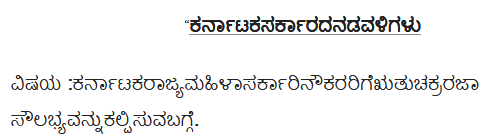
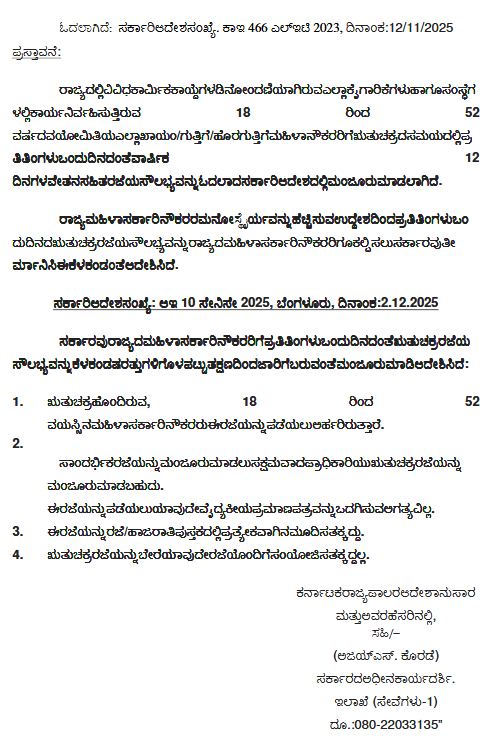
With all this, a Bill is also tabled before the Legislature. The bill is, the "Karnataka Menstrual Leave and Hygiene Bill, 2025". The recommendations of the Law Commission form the objects and reasons of the Bill. The Bill reads as follows:
"The Karnataka Menstrual Leave and Hygiene Bill, 2025
Be it enacted by the Karnataka State Legislature in the th 76 Year of the Republic of India as follows:
1. Short title, extent and commencement.- (1) This Act may be called the Karnataka Menstrual Leave and Hygiene Act, 2025.
(2) It extends to the whole of the State of Karnataka.
(3) It shall come into force on such date as the State Government may by notification in the Official Gazette appoint.
2. Definitions.-
(a)"Authority" means an Authority constituted under Section 5 of the Act.
(b)"Educational Institution" means any primary, secondary or higher secondary school, junior college/pre-university college, degree college, polytechnic, academy, university, institution deemed to be university, training centre, tuition/coaching centre and includes any other institution imparting education and vocational training, whether it is Government, aided or unaided.
(c) "Menstruating person" includes girls, women and transgender persons.
(d)"Private Establishment" means and includes a factory, a mine, a plantation, an establishment wherein persons are employed for the exhibition of equestrian, acrobatics and other performances, cinema and drama theatres, a shop, a motor 21 transport, a concern doing the business or trade or offering service, a company, a firm, a cooperative or any other society, an association, a trust, an agency, an institution, an organisation, a union, a hospital, a clinic, a diagnostic centre, a hotel, or such other establishment, whether registered or not, belonging to or concerning one or more individuals, families, body corporates, etc.
(e) "Services under the aegis of the Government" include the services in the departments of the State Government and in the local Self-Governments, Government Corporations, Government Companies, Government Societies, Public Sector Undertakings, Statutory Boards and Authorities and the similarly placed Instrumentalities of the State. Services include permanent, casual, contract, probationary, part-time, honorary, etc.,.
(f) "Transgender person" means a person whose gender does not match with the gender assigned to that person at birth and includes trans-man or trans-woman (whether or not such person has undergone Sex Reassignment Surgery or hormone therapy or laser therapy or such other therapy), person with intersex variations, genderqueer and person having such socio- cultural identities as kinner, hijra, aravani and jogta.
3. Every menstruating person shall be entitled to the following benefits.-
(a) Paid leave and absence from work upto two days per month in any establishment under the aegis of the State Government or in a private establishment, either consecutively or intermittently as per the requirements during menstruation
(b) In case of menstruating students, leave of absence from the educational institutions upto two days per month during her menstruation and consequently 2% relaxation in the attendance for menstrual issues in Educational Institutions.
Provided that-
(i) The menstruating person shall be entitled to only one day of menstrual leave, if the menstruation falls on Sunday or on any other general holiday.
(ii) The said person shall not be entitled to seek any menstrual leave, if menstruation falls on the days on which the said person is on other leaves.
(iii) The menstruating person may work from home, i.e. work via video-conferencing, if she does not wish to avail of the menstrual leave and if the establishment under the aegis of the State Government or the private establishment gives her the said facility.
(iv) The number of days of menstrual leave in an English calendar year shall not exceed twelve days.
(v) The eligibility for availing of the menstrual leave ends either on attaining menopause or on the employee attaining fifty five years of age, whichever is earlier.
(vi) The unutilized monthly menstrual leave shall not be accumulated and rolled into the subsequent months.
Explanation.- The menstruating person shall avail of the menstrual leave only if the said person encounters serious problems during the menstruation. The production of the medical/doctor's certificate in this regard is not being made mandatory, as it may cause delay,inconvenience and complication in the procedure. A simple leave request or email to the concerned superior authority shall suffice. The availing of the menstrual leave should not be publicized by the higher officers unnecessarily. Menstruating persons may avail of half a day, one day or two days of menstrual leave, but in a responsible way.
4.The Duties of the Government/Management/Employer.- The State and its Instrumentalities/Management of Educational Institutions/Employer in Private Establishments shall-
(a) Provide bio-degradable sanitary pads, menstrual cups, tampons or such sanitary napkins, panty-liners in the separate rest rooms at the cost of Government/Management/Employer, 23 as prescribed by the State Government and/or the Authority constituted under Section 5 of the Act.
(b) Ensure provision of waste dust bins, tissue paper, toilet papers, bags, envelops, newspapers for the safe, secure and easy disposal of menstrual discharge.
(c) Meaningfully observe 28thMay as Menstrual Hygiene Day to create the awareness about the menstrual hygiene and sanitation and organize workshops, public talks, lectures, seminars, discussions at the State, District and Taluka Levels for catalyzing, inspiring and driving impactful actions for providing menstrual health education and access to hygiene products, period-friendly toilets, etc...
5. Constitution of the Menstrual Leave and Hygiene Authority.-
(1) The State Government shall, by notification in the Official Gazette,establish the Authority to be known as "Karnataka Menstrual Leave and Hygiene Authority" for carrying out the purposes of this Act.
(2) The Authority shall consist of the following:
(a) The Chairperson of the Karnataka State Commission for Women shall be the ex-officio Chairperson of the Authority.
(b) The Principal Secretaries of the Departments of (i) Health and Family Welfare (ii) Women and Child Development (iii) Education and(iv) Labour shall be the Ex-officio Members of the Authority.
(c) Two women activists from amongst the lawyers, doctors, trade unions, social service, who have been espousing the cause of women, shall be nominated by the State Government as the members of the Authority.
6. Terms and Conditions of Nominated Members of the Authority.-
(a) The nominated members shall not be entitled to any salary. They are entitled to sitting fees and other allowances, which may be prescribed by the Rules to be made under the Act.
(b) The term of the nominated members shall be three years. No nominated member shall be appointed consecutively for two terms.
7. Functions of the Authority.-
(i) The Authority shall meet once in three months for the redressal of the grievances arising from the complaints received from the menstruating persons under the Act.
(ii) It shall be open to the Authority to take assistance from any officer at the District level and Taluka level for the purpose of enforcing the provisions of the Act, including holding or ordering spot-inspections periodically, getting the reports thereon and passing appropriate orders to ensure full compliance with the provisions of this Act.
(iii) The Authority may issue such directions or instructions to all the public servants within the State of Karnataka as may be necessary for effective implementation of the provisions of this Act and the Rules made thereunder.
(iv) The Authority may impose the penalty, as provided for under Section 9 of the Act.
(v) The Authority shall hold the enquiry following the principles of natural justice, giving full and equal opportunities to both complainant and respondent.
(vi) The Authority, on holding the enquiry, may dismiss the false complaint with or without the costs. It may exonerate the concerned person from the allegations leveled against him, advise or warn him.
(vii) The orders passed by the Authority shall be final.
8. Enforcement Officers for Private Establishments.- (1) The LabourOfficer of each district shall be designated as Enforcement Officer for the purposes of effectively implementing the provisions of the Act and for securing the compliance with the orders of the Authority in private establishments.
(2) The Enforcement Officer shall hold spot-inspections periodically and give instructions to the private establishments 25 to give full effect to the provisions of the Act. He shall submit the report of his inspection to the Authority furnishing the particulars of the shortcomings in the implementation of the Act in the private establishments.
(3) The Authority shall pass the necessary orders on the Enforcement Officer's such report, if any and the same shall be complied with by the concerned individual/officer/employer/ educational institution.
9. Penalty for violation.- Whoever intentionally denies the menstrual leave to a menstruating person, ill-treats or discriminates a menstruating person for availing the menstrual leave or treats the menstruating person as an untouchable shall be liable to pay the penal amount, as imposed by the Authority. The Authority may impose the penalty, which may extend to Rs.5,000/- (Rupees five thousand only) for each contravention of provisions of the Act.
10. Protection of action taken in good faith. No suit, prosecution or other legal proceedings shall lie against the Karnataka Menstrual and Hygiene Authority in respect of anything which is done in good faith or intended to be done in pursuance of this Act and the Rules made thereunder.
11. Power of State Government to make Rules.-
The State Government may, by notification in the official Gazette, make Rules to carry out the purposes of this Act. All the Rules made under this Act shall be laid as soon as may be after they are made before the State Legislative Assembly while it is in session, for a total period of thirty days which may be comprised in one session or in two or more sessions and if before the expiry of that period, the State Legislative Assembly makes any modification in the Rules or directs that any Rule shall not have effect, the Rules shall thereafter have effect only in such modified form or be of no effect, as the case may be.
12. Power to remove difficulties.-
(1) If any difficulty arises in giving effect to the provisions of this Act, the Government may, by order published in the Gazette, make provisions not inconsistent with the provisions of 26 this Act which appear to be necessary or expedient, for removing the difficulty:
Provided that no such order shall be made after the expiry of period of two years from the date of commencement of this Act.
(2) Every order made under this Section shall, as soon as may be after it is made, be laid before the Karnataka State Legislature.
13. Effect of the Act on other laws.-
The provisions of this Act and of any Rules or Orders made thereunder shall have effect notwithstanding anything inconsistent therewith contained in any other law for the time being in force and the provisions of this Act shall be in addition to and not in derogation of any other law for the time being applicable to the Educational Institutions, services under the aegis of the Government and the private establishments."
(Emphasis added at each instance)
10. Long before the Apex Court ruling, a Division Bench of the High Court of Gujarat in NIRJHARI MUKUL SINHA v. UNION OF INDIA (R/WRIT PETITION (PIL) NO. 38 of 2020, disposed on 26-02-2021) highlighted the importance of menstrual process, its awareness to adolescent girls to remove the taboo and to sensitize every sector. The Division Bench while issuing certain directions to prevent the exclusionary practice against women on the basis of their menstrual status, had observed as follows:
".... .... ....
10. It is further submitted that the Social exclusion of women on the basis of their menstrual status is incidental to the proclamation of menstrual status of women. Women have a right over their bodies. The menstrual status of a woman is an attribute of her privacy and person. Requiring a woman and/or following practices that require a woman to reveal her menstrual status is infringement of her right to privacy. She further submitted that the exclusion affects the victimized woman's dignity, results in denial of equal opportunities in the fields of education, work, religion and everydayness of life, instills a feeling of being inadequate and unequal. Such a state of mind is likely to affect mental health of women infringing right to health, resulting in violation of fundamental Rights.
11. Menstruation has been stigmatised in our society. This stigma has built up due to the traditional beliefs in impurity of menstruating women and our unwillingness to discuss it normally. We don't know what may have been the reason that forced the holy men to refer to menstruating women as "unclean". But all religious (excluding Sikhism) refer to menstruating woman as "ritually unclean". The practices mentioned may not be the norm in every household. The degree of following the rules and the practices followed varies from family to family. It depends on their beliefs and how strongly they hold traditional practices.
12. In India, past many decades, mere mention of the topic has been a taboo and even to this date the cultural and social influences appear to be a hurdle for the advancement of knowledge on the subject. Culturally in many parts of India, menstruation is still considered to be dirty and impure. The origin of this myth dates back to the Vedic times and is often been linked to Indra's slaying of Vritras. For, it has been declared in the Veda that the guilt, of killing a brahmana- murder, appears every month as menstrual flow as women had taken upon themselves a part of Indra's guilt. Further, in the Hindu faith, women are prohibited from participating in normal life while 28 menstruating. She must be "purified" before she is allowed to return to her family and day to day chores of her life. However, scientifically it is known that the actual cause of menstruation is ovulation followed by missed chance of pregnancy that results in bleeding from the endometrial vessels and is followed by preparation of the next cycle. Therefore, there seems no reason for this notion to persist that menstruating women are "impure." (vide article authored by Suneela Garg & Taru Anand)
13. Many girls and women are subject to restrictions in their daily lives simply because they are menstruating. Not entering the "puja" room is the major restriction among the urban girls whereas, not entering the kitchen is the main restriction among the rural girls during menstruation. Menstruating girls and women are also restricted from offering prayers and touching holy books. The underlying basis for this myth is also the cultural beliefs of impurity associated with menstruation. It is further believed that menstruating women are unhygienic and unclean and hence the food they prepare or handle can get contaminated. According to study by Kumar and Srivastava in 2011, the participating women also reported that during menstruation the body emits some specific smell or ray, which turns preserved food bad. And, therefore, they are not allowed to touch sour foods like pickles. However, as long as the general hygiene measures are taken into account, no scientific test has shown menstruation as the reason for spoilage of any food in making.
14. Such taboos about menstruation present in many societies impact on girls' and women's emotional state, mentality and lifestyle and most importantly, health. Large numbers of girls in many less economically developed countries drop out of school when they begin menstruating. This includes over 23% of girls in India. In addition to this, the monthly menstruation period also creates obstacles for the female teachers. Thus, the gender-unfriendly school culture and infrastructure and the lack of adequate menstrual protection alternatives and/or clean, safe and private sanitation facilities for female teachers and girls undermine the right of privacy. There are health 29 and hygiene issues also to consider relating to girls and menstruation. Over 77% of menstruating girls and women in India use an old cloth, which is often reused. Further, 88% of women in India sometimes resort to using ashes, newspapers, dried leaves and husk sand to aid absorption. Poor protection and inadequate washing facilities may increases susceptibility to infection, with the odor of menstrual blood putting girls at risk of being stigmatized. The latter may have significant implications for their mental health. The challenge, of addressing the socio-cultural taboos and beliefs in menstruation, is further compounded by the fact the girls' knowledge levels and understandings of puberty, menstruation, and reproductive health are very low.
15. Having regard to the aforesaid, we propose to issue the following directions;
(i) Prohibit social exclusion of women on the basis of their menstrual status at all places, be it private or public, religious or educational;
(ii) The State Government should spread awareness among its citizens regarding social exclusion of women on the basis of their menstrual status through various mediums like putting up posters at public places, including it in school curriculum, using audio visual mediums like radio, entertainment/news channels, short films etc. The first and foremost strategy in this regard is raising the awareness among the adolescent girls related to menstrual health and hygiene. Young girls often grow up with limited knowledge of menstruation because their mothers and other women shy away from discussing the issues with them. Adult women may themselves not be aware of the biological facts or good hygienic practices, instead passing on cultural taboos and restrictions to be observed Community based health education campaigns could prove worthwhile in achieving this task. There is also need to spread awareness among the school teachers regarding menstruation.
(iii) Empowerment of women through education and increasing their role in decision-making can also aid in this regard. Women and girls are often excluded from decision- making due to their lower literacy levels per se. Increasing the education status of women plays an important role in improving the health status of the community at large and overcoming the cultural taboos, in particular.
(iv) Sensitization of health workers, Accredited Social Health Activists and Anganwadi Workers regarding menstruation biology must also be done so that they can further disseminate this knowledge in the community and mobilize social support against busting menstruation related myths. Adolescent Friendly Health Services Clinics must also have trained manpower to address these issues.
(v) The State Government should hold campaigns, drives, involve NGOs and other private organizations to spread such awareness;
(vi) The State Government should include the issue of social exclusion of women on the basis of their menstrual status in all existing campaigns/schemes that aims at menstrual hygiene;
(vii) The State Government should allocate necessary funds for the implementation of the directions;
(viii) The State Government should prohibit all educational institutions, hostels and living spaces for women-studying working and others, private or public, by whatever name called, from following social exclusion of women on the basis of their menstrual status in any manner;
(ix) The State Government should undertake surprise checks, create appropriate mechanism and to take such other actions, steps as may be necessary to ensure its compliance including imposition of appropriate penalty against the erring institution."
11. The Hon'ble Apex Court, in JAYA THAKUR (Dr.) v. UNION OF INDIA (2026 SCC OnLine SC 133), has unequivocally recognized the significance of menstrual health as an integral facet of the right to live with dignity, enshrined under Article 21 of the Constitution of India. In the said decision, the Court has expansively interpreted the right to life so as to include menstrual health within the fold of the right to human dignity, holding it to be a necessary and inseparable concomitant thereof. The Apex Court has undertaken an elaborate exposition on the dimensions of menstrual health, workplace equity, and the necessity of recognizing menstrual health and hygiene as a component of substantive dignity. The Apex Court has held as follows:
"....... ........ ........
C. The right to dignified menstrual health a part of Article 21
i. The right to human dignity as a concomitant of the right to life
69. The right to life under Article 21 means a life with dignity. This Court, in a catena of decisions, has consistently recognized that dignity is an essential and inseparable facet of the right to life and liberty. The right to life means more than mere survival. Every human possesses inherent dignity by virtue of being human, which enables the individual to make self-determining choices. This Court has recognized dignity to be intrinsic and inalienable continuing beyond biological existence.
70. When we recognize dignity as forming a significant part of human existence, we acknowledge the value of life. Dignity makes life livable. There is no gainsaying to the fact that the right to a dignified existence secures decisional autonomy, enabling an individual to transform life from mere subsistence into a meaningful endeavour. Dignity inheres in every stage and every aspect of human existence. As a result, the Constitution protects an individual's expectation that dignity will be preserved and respected throughout their life.
71. In this regard, we shall refer to the decision in K.S. Puttaswamy (Privacy-9 J.) v. Union of India, reported in (2017) 10 SCC 1, wherein this Court categorically held that dignity is an integral part of the Constitution, and its reflections are found in Articles 14, 19, and 21, respectively. This Court noted that dignity can neither be given nor taken away. It held that there is a positive obligation on the State to not only protect one's dignity but also take steps to facilitate it. It was observed that dignity ties all the fundamental rights together. The relevant observations read thus:--
"Jurisprudence on dignity
108. Over the last four decades, our constitutional jurisprudence has recognised the inseparable relationship between protection of life and liberty with dignity. Dignity as a constitutional value finds expression in the Preamble. The constitutional vision seeks the realisation of justice (social, economic and political); liberty (of thought, expression, belief, faith and worship); equality (as a guarantee against arbitrary treatment of individuals) and fraternity (which assures a life of dignity to every individual). These constitutional precepts exist in unity to facilitate a humane and compassionate society. The individual is the focal point of the Constitution because it is in the realisation of individual rights that the collective well-being of the community is determined. Human dignity is an integral part of the Constitution. Reflections of dignity are found in the guarantee against arbitrariness (Article 14), the lamps of freedom (Article 19) and in the right to life and personal liberty (Article 21).
Xxx
113. Human dignity was construed in M. Nagaraj v. Union of India [M. Nagaraj v. Union of India, (2006) 8 SCC 212 : (2007) 1 SCC (L&S) 1013] by a Constitution Bench of this Court to be intrinsic to and inseparable from human existence. Dignity, the Court held, is not something which is conferred and which can be taken away, because it is inalienable : (SCC pp. 243 & 247-48, paras 26 & 42)
"26. ... The rights, liberties and freedoms of the individual are not only to be protected against the State, they should be facilitated by it. ... It is the duty of the State not only to protect the human dignity but to facilitate it by taking positive steps in that direction. No exact definition of human dignity exists. It refers to the intrinsic value of every human being, which is to be respected. It cannot be taken away. It cannot give (sic be given). It simply is. Every human being has dignity by virtue of his existence. ...
***
42. India is constituted into a sovereign, democratic republic to secure to all its citizens, fraternity assuring the dignity of the individual and the unity of the nation. The sovereign, democratic republic exists to promote fraternity and the dignity of the individual citizen and to secure to the citizens certain rights. This is because the objectives of the State can be realised only in and through the individuals. Therefore, rights conferred on citizens and non-citizens are not merely individual or personal rights. They have a large social and political content, because the objectives of the Constitution cannot be otherwise realised."
(emphasis supplied)
119. To live is to live with dignity. The draftsmen of the Constitution defined their vision of the society in which constitutional values would be attained by emphasising, among other freedoms, liberty and dignity. So fundamental is dignity that it permeates the core of the rights guaranteed to the individual by Part III. Dignity is the core which unites the fundamental rights because the fundamental rights seek to achieve for each individual the dignity of existence. Privacy with its attendant values assures dignity to the individual and it is only when life can be enjoyed with dignity can liberty be of true substance. Privacy ensures the fulfilment of dignity and is a core value which the protection of life and liberty is intended to achieve."
(Emphasis supplied)
72. In Common Cause v. Union of India, reported in (2018) 5 SCC 1, Chandrachud, J., opined that the Constitution protects the legitimate expectation of a person to live a life with dignity. The relevant observations read thus:--
"437. Under our Constitution, the inherent value which sanctifies life is the dignity of existence. Recognising human dignity is intrinsic to preserving the sanctity of life. Life is truly sanctified when it is lived with dignity. There exists a close relationship between dignity and the quality of life. For, it is only when life can be lived with a true sense of quality that the dignity of human existence is fully realised. Hence, there should be no antagonism between the sanctity of human life on the one hand and the dignity and quality of life on the other hand. Quality of life ensures dignity of living and dignity is but a process in realising the sanctity of life.
438. Human dignity is an essential element of a meaningful existence. A life of dignity comprehends all stages of living including the final stage which leads to the end of life. Liberty and autonomy are essential attributes of a life of substance. It is liberty which enables an individual to decide upon those matters which are central to the pursuit of a meaningful existence. The expectation that the individual should not be deprived of his or her dignity in the final stage of life gives expression to the central expectation of a fading life : control over pain and suffering and the ability to determine the treatment which the individual should receive. When society assures to each individual a protection against being subjected to degrading treatment in the process of dying, it seeks to assure basic human dignity. Dignity ensures the sanctity of life. The recognition afforded to the autonomy of the individual in matters relating to end- of-life decisions is ultimately a step towards ensuring that life does not despair of dignity as it ebbs away.
xxx
518. Constitutional recognition of the dignity of existence as an inseparable element of the right to life necessarily means that dignity attaches throughout the life of the individual. Every individual has a constitutionally protected expectation that the dignity which attaches to life must subsist even in the culminating phase of human existence. Dignity of life must encompass dignity in the stages of living which lead up to the end of life. Dignity in the process of dying is as much a part of the right to life under Article 21. To deprive an individual of dignity towards the end of life is to deprive the individual of a meaningful existence. Hence, the Constitution protects the legitimate expectation of every person to lead a life of dignity until death occurs;"
(Emphasis supplied)
73. Recently, in Gaurav Kumar v. Union of India, reported in (2025) 1 SCC 641, wherein one of us, J.B. Pardiwala, J., was a part of the Bench, this Court elucidated the importance of dignity in achieving substantive equality. This Court held that dignity encompasses the right of the individual to develop their potential to the fullest. The relevant observations read thus:--
"99. Dignity is crucial to substantive equality. The dignity of an individual encompasses the right of the individual to develop their potential to the fullest. [K.S. Puttaswamy (Privacy-9 J.) v. Union of India, (2017) 10 SCC 1, para 525] The right to pursue a profession of one's choice and earn livelihood is integral to the dignity of an individual. Charging exorbitant enrolment fees and miscellaneous fees as a precondition for enrolment creates a barrier to entry into the legal profession. The levy of exorbitant fees as a precondition to enrolment serves to denigrate the dignity of those who face social and economic barriers in the advancement of their legal careers. [See Neil Aurelio Nunes (OBC Reservation) v. Union of India, (2022) 4 SCC 1, para 35] This effectively perpetuates systemic discrimination against persons from marginalised and economically weaker sections by undermining their equal participation in the legal profession. Therefore, the current enrolment fee structure charged by SBCs is contrary to the principle of substantive equality."
(Emphasis supplied)
74. In our considered view, MHM measures are inseparable from the right to live with dignity under Article 21. We say so because dignity cannot be reduced to an abstract ideal, it must find expression in conditions that enable individuals to live without humiliation, exclusion, or avoidable suffering. For menstruating girl children, the inaccessibility of MHM measures subjects them to stigma, stereotyping, and humiliation.
75. The absence of safe and hygienic menstrual management measures undermines dignified existence by compelling the adolescent female students to either resort to absenteeism or adopt unsafe practices, or both, which violates the bodily autonomy of the menstruating girl children.
ii. The right to privacy and decisional autonomy
76. Dignity cannot be assured without privacy. Privacy is one of the rights that are inherent in a human being by virtue of mere existence. Being a natural right, it inures every individual irrespective of their caste, class, gender, or any other similar differentiating ground. Privacy enables each individual to make choices and take decisions in respect of intimate and personal matters, free from interference. It is this conception of natural and inalienable right that secures the autonomy of human being.
77. In Puttaswamy (supra), this Court held the right to privacy to be a constitutionally protected right under Article 21. It recognized privacy as a natural right which is inherent in a human and not bestowed by the State. It was observed that privacy ensures the fulfilment of dignity and is a core value which protection of life and liberty has intended to achieve. In furtherance of this constitutional protection, the Court held that it is the duty of the State to safeguard the autonomy of an individual. The relevant observations read thus:--
"G. Natural and inalienable rights
42. Privacy is a concomitant of the right of the individual to exercise control over his or her personality. It finds an origin in the notion that there are certain rights which are natural to or inherent in a human being. Natural rights are inalienable because they are inseparable from the human personality. The human element in life is impossible to conceive without the existence of natural rights. In 1690, John Locke had in his Second Treatise of Government observed that the lives, liberties and estates of individuals are as a matter of fundamental natural law, a private preserve. The idea of a private preserve was to create barriers from outside interference. In 1765, William Blackstone in his Commentaries on the Laws of England spoke of a "natural liberty". There were, in his view, absolute rights which were vested in the individual by the immutable laws of nature. These absolute rights were divided into rights of personal security, personal liberty and property. The right of personal security involved a legal and uninterrupted enjoyment of life, limbs, body, health and reputation by an individual.
xxx
46. Natural rights are not bestowed by the State. They inhere in human beings because they are human. They exist equally in the individual irrespective of class or strata, gender or orientation.
xxx
118. Life is precious in itself. But life is worth living because of the freedoms which enable each individual to live life as it should be lived. The best decisions on how life should be lived are entrusted to the individual. They are continuously shaped by the social milieu in which individuals exist. The duty of the State is to safeguard the ability to take decisions -- the autonomy of the individual -- and not to dictate those decisions. "Life" within the meaning of Article 21 is not confined to the integrity of the physical body. The right comprehends one's being in its fullest sense. That which facilitates the fulfilment of life is as much within the protection of the guarantee of life.
xxx
320. Privacy is a constitutionally protected right which emerges primarily from the guarantee of life and personal liberty in Article 21 of the Constitution. Elements of privacy also arise in varying contexts from the other facets of freedom and dignity recognised and guaranteed by the fundamental rights contained in Part III."
(Emphasis supplied)
78. Bobde, J., in his concurring opinion in Puttaswamy (supra), stated that privacy is a prerequisite for the exercise of liberty and the freedom to perform any activity. Consequently, the absence of privacy denies an individual the freedom to exercise that particular liberty or to undertake such activity. Similarly, Nariman, J., recognized the privacy of choice as an individual's autonomy over fundamental choices.
79. As a sequitur, autonomy is a concomitant of privacy. We say so because privacy is founded on the autonomy of an individual. At the same time, dignity cannot exist without privacy. In Puttaswamy (supra), this Court defined autonomy as "the ability to make decision on vital matters of concern to life". While lucidly elucidating facets of privacy, this Court recognized an individual's authority to make decisions as regards their body and mind. Further, while identifying the various facets of privacy, the Court recognized decisional privacy to mean the ability of an individual to make intimate decisions, including those relating to sexual autonomy. The relevant observations read thus:--
"297. What, then, does privacy postulate? Privacy postulates the reservation of a private space for the individual, described as the right to be let alone. The concept is founded on the autonomy of the individual. The ability of an individual to make choices lies at the core of the human personality. The notion of privacy enables the individual to assert and control the human element which is inseparable from the personality of the individual. The inviolable nature of the human personality is manifested in the ability to make decisions on matters intimate to human life. The autonomy of the individual is associated over matters which can be kept private. These are concerns over which there is a legitimate expectation of privacy. The body and the mind are inseparable elements of the human personality. The integrity of the body and the sanctity of the mind can exist on the foundation that each individual possesses an inalienable ability and right to preserve a private space in which the human personality can develop. Without the ability to make choices, the inviolability of the personality would be in doubt. Recognising a zone of privacy is but an acknowledgment that each individual must be entitled to chart and pursue the course of development of personality. Hence privacy is a postulate of human dignity itself. Thoughts and behavioural patterns which are intimate to an individual are entitled to a zone of privacy where one is free of social expectations. In that zone of privacy, an individual is not judged by others. Privacy enables each individual to take crucial decisions which find expression in the human personality. It enables individuals to preserve their beliefs, thoughts, expressions, ideas, ideologies, preferences and choices against societal demands of homogeneity. Privacy is an intrinsic recognition of heterogeneity, of the right of the individual to be different and to stand against the tide of conformity in creating a zone of solitude. Privacy protects the individual from the searching glare of publicity in matters which are personal to his or her life. Privacy attaches to the person and not to the place where it is associated. Privacy constitutes the foundation of all liberty because it is in privacy that the individual can decide how liberty is best exercised. Individual dignity and privacy are inextricably linked in a pattern woven out of a thread of diversity into the fabric of a plural culture.
298. Privacy of the individual is an essential aspect of dignity. Dignity has both an intrinsic and instrumental value. As an intrinsic value, human dignity is an entitlement or a constitutionally protected interest in itself. In its instrumental facet, dignity and freedom are inseparably intertwined, each being a facilitative tool to achieve the other. The ability of the individual to protect a zone of privacy enables the realisation of the full value of life and liberty. Liberty has a broader meaning of which privacy is a subset. All liberties may not be exercised in privacy. Yet others can be fulfilled only within a private space. Privacy enables the individual to retain the autonomy of the body and mind. The autonomy of the individual is the ability to make decisions on vital matters of concern to life. Privacy has not been couched as an independent fundamental right. But that does not detract from the constitutional protection afforded to it, once the true nature of privacy and its relationship with those fundamental rights which are expressly protected is understood. Privacy lies across the spectrum of protected freedoms. [...] Above all, the privacy of the individual recognises an inviolable right to determine how freedom shall be exercised. [...] Read in conjunction with Article 21, liberty enables the individual to have a choice of preferences on various facets of life including what and how one will eat, the way one will dress, the faith one will espouse and a myriad other matters on which autonomy and self-determination require a choice to be made within the privacy of the mind. [...] Dignity cannot exist without privacy. Both reside within the inalienable values of life, liberty and freedom which the Constitution has recognised. Privacy is the ultimate expression of the sanctity of the individual. It is a constitutional value which straddles across the spectrum of fundamental rights and protects for the individual a zone of choice and self-determination."
(Emphasis supplied)
80. In this regard, in Common Cause (supra), this Court held thus:--
"441. The protective mantle of privacy covers certain decisions that fundamentally affect the human life cycle. [Richard Delgado, "Euthanasia Reconsidered -- The Choice of Death as an Aspect of the Right of Privacy", Arizona Law Review (1975), Vol. 17, at p. 474.] It protects the most personal and intimate decisions of individuals that affect their life and development. [Ibid.] Thus, choices and decisions on matters such as procreation, contraception and marriage have been held to be protected. While death is an inevitable end in the trajectory of the cycle of human life of individuals are often faced with choices and decisions relating to death. Decisions relating to death, like those relating to birth, sex, and marriage, are protected by the Constitution by virtue of the right of privacy. The right to privacy resides in the right to liberty and in the respect of autonomy. [T.L. Beauchamp, "The Right to Privacy and the Right to Die", Social Philosophy and Policy (2000), Vol. 17, at p. 276.] The right to privacy protects autonomy in making decisions related to the intimate domain of death as well as bodily integrity.[...]"
(Emphasis supplied)
81. As explained in the aforementioned paragraphs of this judgment, the right to equality does not merely mandate that the State refrains from discrimination but also obliges it to adopt positive and affirmative measures aimed at remedying existing structural disadvantage. Likewise, in Puttaswamy (supra), this Court recognized that privacy has both positive and negative dimensions. In its positive aspect, it imposes an obligation on the State to take all necessary measures to protect the privacy of the individual.
82. What emerges from the foregoing discussion is that a girl child's expectation to manage her menstruation in privacy with dignity is legitimate. In such circumstances, the lack of resources cannot be permitted to govern her autonomy over her own body. There is no doubt that she possesses the right to decide how and where menstrual care is carried out, and the liberty to exercise such care, free from coercive practices and social restrictions.
83. It is apposite to understand that menstrual hygiene management is not confined to sanitation, it includes bodily autonomy and decisional freedom. The denial of adequate facilities, appropriate sanitary products, or privacy effectively compels a girl child to manage her body in a manner dictated by circumstance rather than choice. Autonomy can be meaningfully exercised only when girl children have access to functional toilets, adequate menstrual products, availability of water, and hygienic mechanisms for disposal.
iii. The right to menstrual health as a facet of the right to life
84. The aforesaid may be looked at from one another angle. Article 21 recognizes the right to health. Health is defined as a state of physical, mental, and social well-being and not merely the absence of disease or infirmity. By necessary implication, this right will impliedly extend to the right of a menstruating girl child to access MHM practices to attain the highest standard of sexual and reproductive health. They are intertwined in such a manner that one cannot survive without the other. The right to reproductive health implies that an adolescent female student should have access to safe, effective, and affordable MHM measures.
85. There is a legion of decisions of this Court which lays down that the right to health is an integral facet of the meaningful right to life under Article 21 of the Constitution, and obligations of the State in this regard. We need not discuss all the decisions, but rather intend to refer and rely upon only a few of them.
86. We may refer with profit the decision in Lakshmi Kant Pandey v. Union of India, reported in (1984) 2 SCC 244, wherein this Court highlighted the centrality of children to the nation's growth and development. It was observed that the framers of the Constitution were conscious of the inherent vulnerability of children and hence, reflected in Article 15(3). The relevant observations read thus:--
"6. It is obvious that in a civilized society the importance of child welfare cannot be over-emphasized, because the welfare of the entire community, its growth and development, depend on the health and well-being of its children. Children are a "supremely important national asset" and the future well-being of the nation depends on how its children grow and develop. The great poet Milton put it admirably when he said: "Child shows the man as morning shows the day" and the Study Team on Social Welfare said much to the same effect when it observed that "the physical and mental health of the nation is determined largely by the manner in which it is shaped in the early stages". The child is a soul with a being, a nature and capacities of its own, who must be helped to find them, to grow into their maturity, into fullness of physical and vital energy and the utmost breath, depth and height of its emotional, intellectual and spiritual being; otherwise there cannot be a healthy growth of the nation. Now obviously children need special protection because of their tender age and physique, mental immaturity and incapacity to look after themselves. That is why there is a growing realisation in every part of the globe that children must be brought up in an atmosphere of love and affection and under the tender care and attention of parents so that they may be able to attain full emotional, intellectual and spiritual stability and maturity and acquire self- confidence and self-respect and a balanced view of life with full appreciation and realisation of the role which they have to play in the nation building process without which the nation cannot develop and attain real prosperity because a large segment of the society would then be left out of the developmental process. In India this consciousness is reflected in the provisions enacted in the Constitution. clause (3) of Article 15 enables the State to make special provisions inter alia for children and Article 24 provides that no child below the age of fourteen years shall be employed to work in any factory or mine or engaged in any other hazardous employment. Clauses (e) and (f) of Article 39 provide that the State shall direct its policy towards securing inter alia that the tender age of children is not abused, that citizens are not forced by economic necessity to enter avocations unsuited to their age and strength and that children are given facility to develop in a healthy manner and in conditions of freedom and dignity and that childhood and youth are protected against exploitation and against moral and material abandonment. These constitutional provisions reflect the great anxiety of the Constitution makers to protect and safeguard the interest and welfare of children in the country.
The Government of India has also in pursuance of these constitutional provisions evolved a National Policy for the Welfare of Children. This Policy starts with a goal-oriented preambulatory introduction:
"The nation's children are a supremely important asset. Their nurture and solicitude are our responsibility. Children's programme should find a prominent part in our national plans for the development of human resources, so that our children grow up to become robust citizens, physically fit, mentally alert and morally healthy, endowed with the skills and motivations needed by society. Equal opportunities for development to all children during the period of growth should be our aim, for this would serve our larger purpose of reducing inequality and ensuring social justice."
The National Policy sets out the measures which the Government of India proposes to adopt towards attainment of the objectives set out in the preambulatory introduction and they include measures designed to protect children against neglect, cruelty and exploitation and to strengthen family ties "so that full potentialities of growth of children are realised within the normal family neighbourhood and community environment". The National Policy also lays down priority in programme formation and it gives fairly high priority to maintenance, education and training of orphan and destitute children. There is also provision made in the National Policy for Constitution of a National Children's Board and pursuant to this provision, the Government of India has constituted the National Children's Board with the Prime Minister as the chair-person. It is the function of the National Children's Board to provide a focus for planning and review and proper co-ordination of the multiplicity of services striving to meet the needs of children and to ensure at different levels continuous planning, review and co-ordination of all the essential services. The National Policy also stresses the vital role which the voluntary organisations have to play in the field of education, health, recreation and social welfare services for children and declares that it shall be the endeavour of State to encourage and strengthen such voluntary organisations."
(Emphasis supplied)
87. In a petition filed under Article 32, issues arising from occupational health hazards and diseases affecting workmen employed in asbestos industries fell for consideration before this Court in Consumer Education & Research Centre v. Union of India, reported in (1995) 3 SCC 42. A three Judge Bench of this Court held that the right to health of a workman is an integral facet of the meaningful right to life. It encompasses not only healthy existence but also a robust and healthy lifestyle. This Court held that the right to health and medical care is a fundamental right under Article 21 read with Articles 39(e), 41 and 43 of the Constitution respectively, insofar as the life of the workman is considered to make it meaningful and dignified. It was further held that the State is under an obligation to promote health of a workman. The relevant observations read thus:--
"20. Article 1 of the Universal Declaration of Human Rights asserts human sensitivity and moral responsibility of every State that "all human beings are born free and equal in dignity and rights. They are endowed with reason and conscience and should act towards one another in a spirit of brotherhood." The Charter of the United Nations thus reinforces the faith in fundamental human rights and in the dignity and worth of human person envisaged in the Directive Principles of State Policy as part of the Constitution. The jurisprudence of personhood or philosophy of the right to life envisaged under Article 21, enlarges its sweep to encompass human personality in its full blossom with invigorated health which is a wealth to the workman to earn his livelihood, to sustain the dignity of person and to live a life with dignity and equality.
xxx
23. In Sunil Batra v. Delhi Admn., [(1978) 4 SCC 494 : 1979 SCC (Cri) 155], considering the effect of solitary confinement of a prisoner sentenced to death and the meaning of the word 'life' enshrined under Article 21, the Constitution Bench held that the quality of life covered by Article 21 is something more than the dynamic meaning attached to life and liberty. The same view was reiterated in Board of Trustees of the Port of Bombay v. D.R. Nadkarni [(1983) 1 SCC 124 : 1983 SCC (L&S) 61], Vikram Deo Singh Tomar v. State of Bihar [1988 Supp SCC 734 : 1989 SCC (Cri) 66], Ramsharan Autyanuprasi v. Union of India [1989 Supp (1) SCC 251]. In Charles Sobraj v. Supdt., Central Jail, Tihar [(1978) 4 SCC 104 : 1978 SCC (Cri) 542 : AIR 1978 SC 1514] this Court held that the right to life includes right to human dignity. The right against torture, cruel or unusual punishment or degraded treatment was held to violate the right to life. In Bandhua Mukti Morcha v. Union of India [(1984) 3 SCC 161 : 1984 SCC (L&S) 389] at pp. 183-84 this Court held that the right to live with human dignity, enshrined in Article 21, derives its life-breath from the Directive Principles of State Policy and particularly clauses (e) and (f) of Article 39 and Articles 41 and 42. In C.E.S.C. Ltd. v. Subhash Chandra Bose [(1992) 1 SCC 441 : 1992 SCC (L&S) 313] this Court considered the gamut of operational efficacy of human rights and constitutional rights, the right to medical aid and health and held that the right to social justice are fundamental rights. Right to free legal aid to the poor and indigent worker was held to be a fundamental right in Khatri (II) v. State of Bihar [(1981) 1 SCC 627 : 1981 SCC (Cri) 228]. Right to education was held to be a fundamental right vide Maharashtra State Board of Secondary & Higher Secondary Education v. K.S. Gandhi [(1991) 2 SCC 716] and Unni Krishnan, J.P. v. State of A.P. [(1993) 1 SCC 645]
24. The right to health to a worker is an integral facet of meaningful right to life, to have not only a meaningful existence but also robust health and vigour without which worker would lead life of misery. Lack of health denudes him of his livelihood. Compelling economic necessity to work in an industry exposed to health hazards due to indigence to bread-winning for himself and his dependants, should not be at the cost of the health and vigour of the workman. Facilities and opportunities, as enjoined in Article 38, should be provided to protect the health of the workman. Provision for medical test and treatment invigorates the health of the worker for higher production or efficient service. Continued treatment, while in service or after retirement is a moral, legal and constitutional concomitant duty of the employer and the State. Therefore, it must be held that the right to health and medical care is a fundamental right under Article 21 read with Articles 39(e), 41 and 43 of the Constitution and make the life of the workman meaningful and purposeful with dignity of person.
Right to life includes protection of the health and strength of the worker and is a minimum requirement to enable a person to live with human dignity. The State, be it Union or State Government or an industry, public or private, is enjoined to take all such actions which will promote health, strength and vigour of the workman during the period of employment and leisure and health even after retirement as basic essentials to live the life with health and happiness. The health and strength of the worker is an integral facet of right to life. Denial thereof denudes the workman the finer facets of life violating Article 21. The right to human dignity, development of personality, social protection, right to rest and leisure are fundamental human rights to a workman assured by the Charter of Human Rights, in the Preamble and Articles 38 and 39 of the Constitution. Facilities for medical care and health to prevent sickness ensures stable manpower for economic development and would generate devotion to duty and dedication to give the workers' best physically as well as mentally in production of goods or services. Health of the worker enables him to enjoy the fruits of his labour, keeping him physically fit and mentally alert for leading a successful life, economically, socially and culturally. Medical facilities to protect the health of the workers are, therefore, the fundamental and human rights to the workmen.
25. Therefore, we hold that right to health, medical aid to protect the health and vigour of a worker while in service or post-retirement is a fundamental right under Article 21, read with Articles 39(e), 41, 43, 48-A and all related articles and fundamental human rights to make the life of the workman meaningful and purposeful with dignity of person."
(Emphasis supplied)
88. In Devika Biswas v. Union of India, reported in (2016) 10 SCC 726, a petition before this Court raised issues, inter alia, regarding the conduct and management of sterilization procedures, more particularly, the death occurring therefrom. In this regard, the Court held that the right to reproductive health encompasses the right to make all allied decisions and to attain the highest standards of reproductive health. The relevant observations read thus:--
"(i) Right to health
107. It is well established that the right to life under Article 21 of the Constitution includes the right to lead a dignified and meaningful life and the right to health is an integral facet of this right. In CESC Ltd. v. Subhash Chandra Bose [CESC Ltd. v. Subhash Chandra Bose, (1992) 1 SCC 441 : 1992 SCC (L&S) 313] dealing with the right to health of workers, it was noted that the right to health must be considered an aspect of social justice informed by not only Article 21 of the Constitution, but also the Directive Principles of State Policy and international covenants to which India is a party. Similarly, the bare minimum obligations of the State to ensure the preservation of the right to life and health were enunciated in Paschim Banga Khet Mazdoor Samity v. State of W.B. [Paschim Banga Khet Mazdoor Samity v. State of W.B., (1996) 4 SCC 37]
108. In Bandhua Mukti Morcha v. Union of India [Bandhua Mukti Morcha v. Union of India, (1984) 3 SCC 161 : 1984 SCC (L&S) 389] this Court underlined the obligation of the State to ensure that the fundamental rights of weaker sections of society are not exploited owing to their position in society.
xxx
(ii) Right to reproductive health
110. Over time, there has been recognition of the need to respect and protect the reproductive rights and reproductive health of a person. Reproductive health has been defined as "the capability to reproduce and the freedom to make informed, free and responsible decisions. It also includes access to a range of reproductive health information, goods, facilities and services to enable individuals to make informed, free and responsible decisions about their reproductive behaviour". [WHO, Sexual Health, Human Rights and the Law (2015) cited from Committee on Economic, Social and Cultural Rights, General Comment No. 22 (2016) on the Right to Sexual and Reproductive Health (Article 12 of the International Covenant on Economic, Social and Cultural Rights), 2-5-2016, E/C.12/GC/22 at para 6 https://documents-dds- ny.un.org/doc/UNDOC/GEN/G16/089/32/PDF/G16 08932.pdf?OpenElement.] The Committee on Economic, Social and Cultural Rights in General Comment No. 22 on the Right to Sexual and Reproductive Health under Article 12 of the International Covenant on Economic, Social and Cultural Rights [India ratified this Convention on 10-4-1979.] observed that "The right to sexual and reproductive health is an integral part of the right of everyone to the highest attainable physical and mental health." [General Comment No. 22 (2016) on the Right to Sexual and Reproductive Health (Article 12 of the International Covenant on Economic, Social and Cultural Rights), E/C.12/GC/22 https://documents-dds-ny.un.org/doc/UNDOC/ GEN/G16/089/32/PDF/G1608932.pdf?OpenElement.]
111. This Court recognised reproductive rights as an aspect of personal liberty under Article 21 of the Constitution in Suchita Srivastava v. Chandigarh Admn. [Suchita Srivastava v. Chandigarh Admn., (2009) 9 SCC 1 : (2009) 3 SCC (Civ) 570] The freedom to exercise these reproductive rights would include the right to make a choice regarding sterilisation on the basis of informed consent and free from any form of coercion. f...]
112. It is necessary to reconsider the impact that policies such as the setting of informal targets and provision of incentives by the Government can have on the reproductive freedoms of the most vulnerable groups of society whose economic and social conditions leave them with no meaningful choice in the matter and also render them the easiest targets of coercion. The cases of Paschim Banga Khet Mazdoor Samity [Paschim Banga Khet Mazdoor Samity v. State of W.B., (1996) 4 SCC 37] and Bandhua Mukti Morcha [Bandhua Mukti Morcha v. Union of India, (1984) 3 SCC 161 : 1984 SCC (L&S) 389] have emphasised that the State's obligation in respect of fundamental rights must extend to ensuring that the rights of the weaker sections of the community are not exploited by virtue of their position. Thus, the policies of the Government must not mirror the systemic discrimination prevalent in society but must be aimed at remedying this discrimination and ensuring substantive equality. In this regard, it is necessary that the policies and incentive schemes are made gender neutral and the unnecessary focus on female sterilisation is discontinued."
(Emphasis supplied)
89. The views expressed by this Court in Independent Thought v. Union of India, reported in (2017) 10 SCC 800, are commendable. It held that the concept of good health is not limited to physical well-being but rather a girl child's right to grow into a healthy woman, to exercise choice, and to pursue education. It was observed that when a girl child is deprived of the opportunity to study further, her right to live a dignified life as a woman is also violated. The Court further emphasized that a girl child must not only be afforded equality of opportunity with a male child, but must also be provided with additional support, so as to enable her empowerment physically, mentally, and economically. The relevant observations read as under:--
"179. There can be no dispute that every citizen of this country has the right to get good healthcare. Every citizen can expect that the State shall make best endeavours for ensuring that the health of the citizen is not adversely affected. By now it is well settled by a catena of judgments of this Court that the "right to life" envisaged in Article 21 of the Constitution of India is not merely a right to live an animal existence. This Court has repeatedly held that right to life means a right to live with human dignity. Life should be meaningful and worth living. Life has many shades. Good health is the raison d'être of a good life. Without good health there cannot be a good life. In the case of a minor girl child good health would mean her right to develop as a healthy woman. This not only requires good physical health but also good mental health. The girl child must be encouraged to bloom into a healthy woman. The girl child must not be deprived of her right of choice. The girl child must not be deprived of her right to study further. When the girl child is deprived of her right to study further, she is actually deprived of her right to develop into a mature woman, who can earn independently and live as a self-sufficient independent woman. In the modern age, when we talk of gender equality, the girl child must be given equal opportunity to develop like a male child. In fact, in my view, because of the patriarchal nature of our society, some extra benefit must be showered upon the girl child to ensure that she is not deprived of her right to life, which would include her right to grow and develop physically, mentally and economically as an independent self-sufficient female adult."
(Emphasis supplied)
90. A three Judge Bench of this Court in X2 v. State (NCT of Delhi), reported in (2023) 9 SCC 433, wherein one of us, J.B. Pardiwala, J., was part of the Bench, held that the right to decide on all matters relating to sexual and reproductive health is one flower in the bouquet of reproductive rights. It held that reproductive rights include the right to access education and information about sexual health. The relevant observations read thus:--
"101. The ambit of reproductive rights is not restricted to the right of women to have or not have children. It also includes the constellation of freedoms and entitlements that enable a woman to decide freely on all matters relating to her sexual and reproductive health. Reproductive rights include the right to access education and information about contraception and sexual health, the right to decide whether and what type of contraceptives to use, the right to choose whether and when to have children, the right to choose the number of children, the right to access safe and legal abortions, and the right to reproductive healthcare. Women must also have the autonomy to make decisions concerning these rights, free from coercion or violence."
(Emphasis supplied)
91. It is limpid that when a girl child cannot access menstrual absorbents, she may resort to natural materials, newspaper, cloth, tissue, cotton wool, or any other unhygienic absorbent. In case of a lack of adequate clean water and soap, she may also struggle to properly clean and dry herself. It is not unknown that poor menstrual hygiene may cause reproductive tract infections such as bacterial vaginosis, which may in turn lead to infertility.
92. Lack of knowledge about menstruation may lead to unhygienic and negative practices. This lack of body literacy contributes to a feeling of lack of bodily autonomy, more particularly, with regards to reproductive choices.
93. The above conspectus of cases reveals that the State bears a positive obligation under Article 21 to protect the right to health, more particularly, the menstrual health of girl children. The State is required to undertake effective measures to ensure the availability of, and enhance access to MHM products. We say so because the lack of access to such products impedes the physical well-being, dignity, and overall development of menstruating girl children.
94. It is an admitted position that the lack of access to MHM violates the right to reproductive health, as it compels girl children to resort to unhygienic alternatives such as rags or cloth, or use of menstrual absorbents for prolonged periods, all of which have demonstrably adverse consequences for their health. In schools where there are no separate washrooms for girl students, they would have to use male washrooms or the one which is used by all the students, where they are prone to harassment or sexual assault.
95. In such circumstances referred to above, it is the duty of the State to ensure the availability of MHM measures flows from the positive obligation embodied in Article 15(3) of the Constitution. The Constitution expressly contemplates discrimination in favour of women and children, having due regard to their vulnerability, in order to safeguard their welfare and interests. This constitutional intent is also reflected in Articles 24 and 39(e) and (f) of the Constitution, respectively.
96. It would be worthwhile to refer to the observations made by this Court in State of A.P. v. P.B. Vijaykumar, reported in (1995) 4 SCC 520, wherein this Court had the occasion to interpret the expression "any special provision for women" in Article 15(3) of the Constitution. In such circumstances, it was observed that the object of the clause is to strengthen and improve the status of women. The Court held that the special provision referred in Article 15(3) could be either in the form of affirmative action or reservation.
"7. The insertion of clause (3) of Article 15 in relation to women is a recognition of the fact that for centuries, women of this country have been socially and economically handicapped. As a result, they are unable to participate in the socio-economic activities of the nation on a footing of equality. It is in order to eliminate this socio-economic backwardness of women and to empower them in a manner that would bring about effective equality between men and women that Article 15(3) is placed in Article 15. Its object is to strengthen and improve the status of women.[...]
8. What then is meant by "any special provision for women" in Article 15(3)? This "special provision", which the State may make to improve women's participation in all activities under the supervision and control of the State can be in the form of either affirmative action or reservation. It is interesting to note that the same phraseology finds a place in Article 15(4) which deals with any special provision for the advancement of any socially or educationally backward class of citizens or Scheduled Castes or Scheduled Tribes.[...] This Court has, therefore, clearly considered the scope of Article 15(4) as wider than Article 16(4) covering within it several kinds of positive action programmes in addition to reservations. It has, however, added a word of caution by reiterating M.R. Balaji [1963 Supp 1 SCR 439 : AIR 1963 SC 649] to the effect that a special provision contemplated by Article 15(4) like reservation of posts and appointments contemplated by Article 16(4), must be within reasonable limits. These limits of reservation have been broadly fixed at 50% at the maximum. The same reasoning would apply to Article 15(3) which is worded similarly.
(Emphasis supplied)
97. The State's obligation is heightened insofar as a girl child belonging to economically weaker sections is concerned. We say so because such students are placed in a position of coalesced vulnerability. The economic burden of sanitary products compounds the existing disadvantage of, first, being a girl in a structurally unequal society; secondly, having a biological process that requires management; and thirdly, lacking the financial means to manage that process in a safe and hygienic manner.
98. Furthermore, to secure the right to health is not merely a right enshrined under Article 21 but also a duty on the State under Article 47 of the Constitution. Article 47 enjoins the State to improve public health as its primary duty. No doubt the Government is rendering this obligation by providing MHM measures but in order to make it meaningful, it has to be reach of the beneficiaries. Thus, it is only then the objectives of the State can be realized. As is always said, the rights conferred on citizens and non- citizens are not merely individual or personal rights. They have a large social and political content, because the objectives of the Constitution cannot be otherwise realized.[M. Nagaraj v. Union of India, (2006) 8 SCC 212.] If the Government Order and the proposed Bill are examined on the touchstone of the aforesaid authoritative pronouncement in JAYA THAKUR's case supra, what unmistakably emerges is that the policy concerning the grant of menstrual leave is not merely a matter of administrative discretion, but is intrinsically connected to the realization of a fundamental right. Any measure undertaken by the State towards securing menstrual health and dignity, in the considered view of this Court, directly engages and advances the guarantees enshrined under Article 21 of the Constitution. The Apex Court, having thus elaborately delineated the contours of menstrual health, has in clear and unequivocal terms held that the right to menstrual dignity forms a part of the right to life itself.
12. The Policy, by the Government order on 20-11-2025, and later the bill did not spring from air. It has roots traceable to Article 21 of the Constitution of India. Apart from that, the bill has taken birth from, the womb of the Constitution of India, particularly Articles 15(3), 39(e) and 42 and they read as follows:
"15. Prohibition of discrimination on grounds of religion, race, caste, sex or place of birth.
... ... ...
(3) Nothing in this article shall prevent the State from making any special provision for women and children.
... ... ...
39. Certain principles of policy to be followed by the State.
... ...
(e) that the health and strength of workers, men and women, and the tender age of children are not abused and that citizens are not forced by economic necessity to enter avocations unsuited to their age or strength;
... ... ...
42. Provision for just and humane conditions of work and maternity relief.--The State shall make provision for securing just and humane conditions of work and for maternity relief."
Article 15(3) of the Constitution does not impose any fetter upon the State in making special provisions for women and children. It bestows the State, Authority to enact measures to initiate policies towards safeguarding the health and strength of workers, both men and women, ensuring that neither is subjected to conditions that undermine their wellbeing. Article 42 further elevates this mandate, by requiring the State to secure just and humane conditions of work, alongside the provision of maternity relief, their embedding compassion within the framework of labour jurisprudence. The executive power of the State flowing from Article 162 of the Constitution of India, furnishes the necessary authority to translate these constitutional aspirations into tangible policy measures. It is too well settled a principle of law that the State can bring about policies in exercise of its executive power under Article 162 of the Constitution of India. The State has articulated the present policy and has proceeded to usher in the proposed legislation, thereby giving concrete expression to the spirit and intent of the Constitution.
13. The significance of menstrual leave policy is not merely administrative, but deeply rooted in the Constitutional promise of equality that embraces all citizens, beneath its expansive canopy. While the law proclaims men and women as equals, nature, in its intricate design, has bestowed upon women, certain biological experiences that set them apart - menstruation being one such profound reality. Menstruation, often referred to as periods, is not an aberration, but a natural and indispensable facet of women's reproductive cycle. It is a recurring monthly phenomenon wherein, the body governed by delicate hormonal rhythms sheds the uterine lining resulting in bleeding, that typically endures for 3 to 7 days. Yet beyond its clinical description lies a lived experience, one that may be accompanied by discomfort, fatigue, and emotional upheavals. True, equality, as envisioned by the Constitution, demands a more compassionate and nuanced approach, one that acknowledges difference not as a ground for discrimination, but as a basis for accommodation. Thus, the call for menstrual leave, is not a plea for privilege, but an assertion of dignity, fairness and humane understanding within the spaces women inhabit.
14. It is also necessary to notice the challenges encountered by menstruating women as a consequence of their menstrual cycle, all of which are well-recognized and in public domain.
PROBLEMS FACED BY MENSTRUATING WOMEN DUE TO THE MENSTRUAL CYCLE:
(a) Among the most prevalent afflictions experienced during menstruation is dysmenorrhea--commonly referred to as menstrual cramps or painful periods. This condition often manifests as acute discomfort in the pelvic region, abdomen, or lower back, and in certain instances, the intensity of pain can be profoundly debilitating. Scholarly studies have consistently identified dysmenorrhea as a significant gynaecological concern worldwide, contributing not only to absenteeism from educational institutions and workplaces but also to a marked deterioration in overall quality of life. Accompanying symptoms such as backaches, headaches, nausea, light-headedness, and even fainting further compound the distress endured during this phase.
(b) At times, irregularities in the menstrual cycle serve as harbingers of more serious underlying disorders. For instance, menorrhagia--characterized by abnormally heavy or prolonged bleeding--may signal hormonal imbalances or other medical complications that warrant careful attention.
(c) Excessive menstrual bleeding also elevates the risk of iron-deficiency anaemia, a condition marked by profound fatigue, weakness, and dizziness. When severe or chronic, anaemia can precipitate grave complications, particularly during pregnancy, and may give rise to broader physiological impairments.
(d) The hormonal fluctuations intrinsic to the menstrual cycle extend their influence beyond the physical realm, giving rise to an array of emotional and psychological symptoms. These may range from bodily soreness, headaches, and muscle pain to heightened anxiety and depressive states. While commonly classified under premenstrual syndrome (PMS), more severe and incapacitating manifestations are recognized as premenstrual dysphoric disorder (PMDD).
(e) Compounding these physiological challenges is the pervasive stigma that surrounds menstruation--a stigma deeply entrenched in societal norms and cultural practices. Menstruating women are often deemed "impure" and subjected to exclusionary customs, such as being barred from entering kitchens or participating in routine activities, under the misguided belief that they may contaminate their surroundings. Such practices perpetuate social alienation and reinforce harmful misconceptions.
(f) In addition, several medical conditions associated with menstruation--such as endometriosis, polycystic ovary syndrome (PCOS), premenstrual dysphoric disorder (PMDD), and uterine fibroids--present with diverse yet often severe symptoms, including heavy bleeding, unpredictable cycles, and chronic pain. These conditions may also heighten susceptibility to infections of the reproductive system. Disturbingly, many of these disorders remain misdiagnosed or entirely undiagnosed for extended periods, depriving individuals of timely and effective treatment.
(g) Menstrual health conditions may also adversely impact fertility and safe childbirth. Endometriosis, affecting approximately 10-15% of women of reproductive age, stands as one of the leading causes of infertility. Similarly, PCOS, which affects around 10% of women in this demographic, is associated not only with infertility but also with heightened risks during pregnancy, including preterm delivery, gestational diabetes, preeclampsia, miscarriage, and even fetal loss. While uterine fibroids may not always hinder conception, they can significantly complicate pregnancy and childbirth, potentially leading to pregnancy loss or restricted fetal growth.
15. PROBLEMS FACED BY MENSTRUATING WOMEN AT THE WORKPLACE:
(a) Within professional environments, menstruation remains an often-overlooked reality. Workplaces are seldom designed with the needs of menstruating individuals in mind, much like they frequently fail to accommodate pregnancy and childbirth. In the absence of appropriate provisions, employees may find their productivity diminished or feel compelled to take leave during their menstrual cycles.
(b) The lack of access to proper facilities can have serious health implications. When individuals are unable to change menstrual products as required, they may resort to makeshift alternatives such as tissues or paper towels, increasing the risk of irritation, infection, and, in rare cases, toxic shock syndrome.
(c) Inadequate workplace support may also deter individuals from pursuing professional opportunities or even compel them to exit the workforce altogether. Common challenges include insufficient menstrual hygiene facilities, lack of inclusive leave policies, social discomfort, limited access to menstrual products, and pervasive stigma.
(d) Furthermore, the absence of clean, well-equipped restrooms stocked with menstrual hygiene products places an undue burden on employees, who must often carry their own supplies. Providing free and readily accessible sanitary products-- such as pads, tampons, or menstrual cups--can substantially alleviate this stress and foster a more supportive work environment.
(e) To address these concerns, workplaces must ensure the availability of menstrual-friendly restrooms, secure storage spaces for personal items, and facilities for changing clothing when necessary. Additionally, provisions such as access to quiet resting areas and flexible arrangements allowing employees to sit, stand, or stretch can help mitigate fatigue associated with hormonal fluctuations.
INTERNATIONAL ORGANIZATIONS:
16. RECOGNITION OF MENSTRUAL HEALTH AS A HUMAN RIGHTS ISSUE:
(a) The World Health Organization has emphatically advocated for the recognition of menstrual health as a fundamental health and human rights issue, rather than confining it merely to the domain of hygiene. It calls for a holistic understanding that encompasses the physical, psychological, and social dimensions of menstruation across the entire life course - from menarche to menopause.
(b) Menstrual health, in its truest sense, necessitates that women, girls, and all individuals who menstruate have access to accurate information, adequate education, appropriate menstrual products, and safe water, sanitation, and disposal facilities. It also entails access to compassionate and competent healthcare, and the assurance of environments--whether at home, school, or workplace--where menstruation is regarded as a natural and healthy phenomenon, free from shame or stigma. Crucially, it underscores the right to participate fully and equally in all aspects of life during menstruation.
(c) The WHO further emphasizes the need to integrate menstrual health considerations into sectoral policies, planning, and budgeting, ensuring that progress is measurable and sustained.
EVOLVING GLOBAL LANDSCAPE:
17. It is pertinent to take cognizance of the evolving global landscape, wherein several Nations through legislative enactments, policy formulation or ongoing deliberative processes, sought to recognize and institutionalize menstrual leave. This emerging international consensus, reflects a growing acknowledgment of menstruation, not merely as a private biological occurrence, but a matter warranting policy intervention within the realm of labour rights and human dignity. The Nations that have brought in or deliberating to bring in a policy for menstrual leave are as follows:
SOVIET UNION:
In 1922 and 1931, the Soviet Union introduced the "Special Protective Labor Laws" which set out the terms for menstrual leave. The Bolshevik menstrual policy was directed at women working in factory jobs, providing them with two to three days paid leave during menstruation. Menstrual leave was introduced by the Soviet State as a policy designed to "protect the health of women workers in order that they should be able to fulfil their reproductive and maternal functions." Menstrual leave was thus entangled with Soviet pronatalist ideology, which envisaged specific female "roles and duties in the process of socialist construction."
JAPAN:
In Japan, menstrual leave, or "Seirikyuuka", came onto the political agenda around the same time as the Soviet Union, but for different reasons. In 1928, female conductors for the Tokyo Municipal Bus Company went on strike demanding menstrual leave be provided for industrial reasons. However, collective demands for menstrual leave did not translate into formal policy until the post- war period, when inadequate workplace sanitation emerged as a national labour concern. Menstrual leave was subsequently incorporated in the "National Labor Standards Act 1947 [Act No 49 of 1947]" and remains active. Article 68 of the Act reads as follows:
"When a woman for whom work during menstrual periods would be especially difficult has requested to leave, the Employer shall not have said woman work on days of said menstrual period."
INDONESIA:
Indonesia was the third country to implement a national policy for menstrual leave in the early 20th century. The original policy was established in 1948 and then restructured in 2003 as part of a legislative reform process which, left the right to menstrual leave intact but with "specific provisions located in company regulations and enterprise agreements". Article 81(1) of the "Law Number 13/2003 Concerning Manpower" reads as follows:
"Female workers/ labourers who feel pain during their menstrual period and tell the entrepreneur about this are not obliged to come to work on the first and second day of menstruation."
The 2003 Reforms weakened menstrual leave as a workplace entitlement, as the law no longer mandated two days paid leave but rather made the policy "subject to negotiation between employers and enterprise unions" with no enforceable payment mechanism.
SOUTH KOREA:
Ratified in the year 2001, Article 73 of the "Labour Standards Act [Act No. 5309/1997]" provides for one day of unpaid leave per month, awarded at the employee's request. Article 73 reads as follows:
"An employer shall, upon request of a female worker, grant her one-day menstruation leave per month."
Employers do not have discretion to deny menstrual leave and all female employees are entitled to the benefit irrespective of job status or how long they have worked for their employer. There are criminal penalties for non compliance and employers who violate the law are liable for payment of a fine not exceeding five million won.
TAIWAN:
Enacted in the year 2002, Taiwan's menstrual leave policy is incorporated in the Gender Equality in Employment Act. Article 14 of the Act allows a maximum of day menstrual leave per month with employees receiving half of their regular wage. Article 14 reads as follows:
"(I)Female employee having difficulties in performing her work during menstruation period may request one day menstrual leave each month. If the cumulative menstrual leaves do not exceed three days in a year, said leaves shall not be counted toward days off for sick leave. All additional menstrual leaves shall be counted toward days off for sick leave.
(II)Wages for menstrual leaves, whether said leaves are sick leaves or non-sick leaves as prescribed in the preceding Paragraph, shall be half the regular wage."
Unlike China and South Korea, the drafting of Taiwan's menstrual leave policy is intricately connected to the provision of common sick leave. Under the non-amended entitlement, women were entitled to menstrual leave, but this was integrated into the 30 days of sick leave which also provided for half pay. Thus, if a woman claimed three days menstrual leave, this would only leave 27 days of common sick leave for the year. The new scheme, established in 2013, sought to change this integrated framework, with legislators arguing the deduction of menstrual leave from common sick leave was unfair and a violation of women's basic rights. While women are entitled to 33 days of leave post- amendment, if an employee exceeds 30 days leave (including common sick leave and menstrual leave) then the additional three days are unpaid.
VIETNAM:
Vietnam formally incorporated the Menstrual Leave Policy in its "National Labour Code [Decree No 85/2015]" in November 2015.
Article 137(4) of the Code provides a break for thirty minutes per day to a female employee during her menstrual period. Article 137(4) reads as follows:
"4. A female employee in her menstruation period shall be entitled to a 30 minute break in every working day; a female employee nursing a child under 12 months of age shall be entitled to a 60-minute break in every working day with full wage as stated in the labor contract."
ZAMBIA:
Zambia introduced the Menstrual Leave Policy in the year 2015, which was officially called the "Mother's Day" which allows female employees to take one discretionary off each month. Article 47 of the "Employment Code Act 2019" reads as follows:
"Mother's day
47. A female employee is entitled to one day's absence from work each month without having to produce a medical certificate or give reason to the employer."
Article 47 states that no certificate or reason is required to be given to the employer while availing the menstrual leave.
18. I have deemed it appropriate to advert to the aforesaid discussion, for the reason that it reflects a remarkable unity of thought, in favour of granting menstrual leave to women, during their menstrual cycle, at the very least, for a day. Indeed, it is of some significance that the Union of India, has, on two separate occasions, introduced bills contemplating the grant of minimum of two days' paid menstrual leave per month. It is equally noteworthy that similar legislative initiative was undertaken in the State of Arunachal Pradesh, however, the bill was ultimately withdrawn in the face of opposition.
UNORGANIZED SECTOR:
19. The question that now arises pertains to the scope of applicability of the Government Orders, which in their present form are confined to the organized sector. The position of the unorganized sector therefore warrants careful consideration.
19.1. The Apex Court in MUNICIPAL CORPORATION OF INDIA v. FEMALE WORKERS (MUSTER ROLL) ((2000) 3 SCC 224) while interpreting Maternity Benefit Act, 1961 and as to its implementation to the female muster roll workers engaged by the Municipal Corporation of Delhi observes as follows:
"....... ........ ........
33. A just social order can be achieved only when inequalities are obliterated and everyone is provided what is legally due. Women who constitute almost half of the segment of our society have to be honoured and treated with dignity at places where they work to earn their livelihood. Whatever be the nature of their duties, their avocation and the place where they work, they must be provided all the facilities to which they are entitled. To become a mother is the most natural phenomenon in the life of a woman. Whatever is needed to facilitate the birth of child to a woman who is in service, the employer has to be considerate and sympathetic towards her and must realise the physical difficulties which a working woman would face in performing her duties at the workplace while carrying a baby in the womb or while rearing up the child after birth. The Maternity Benefit Act, 1961 aims to provide all these facilities to a working woman in a dignified manner so that she may overcome the state of motherhood honourably, peaceably, undeterred by the fear of being victimised for forced absence during the pre-or post-natal period."
19.2. The Apex Court again in AJAY MALIK v. STATE OF UTTARAKHAND (2025 SCC OnLine SC 185) while noticing several enactments which are yet to reach domestic workers on the score that domestic workers lack legal protection in the nation has observed as follows:
"....... ........ ........
42. Before we discuss the Indian legal experience with domestic workers, it is perhaps fitting to advert to the prevailing international standards.
D. 4.2 International norms and standards
43. In the international spectrum, over the course of many decades, the ILO has provided various guidelines and conventions for the betterment of labour laws across the world. It is noteworthy that it has also extensively sought to protect the rights of domestic workers, which it recognises as a uniquely disadvantaged and marginalised class. It proactively advocates for the inclusion of domestic workers in pre-existing labour treaties. For instance, during discussions on the Protection of Workers' Claims (Employer's Insolvency) Convention, 1992 (No. 173), the definition of 'insolvency' was revised to refer to as 'employer's assets' instead of the narrower term 'enterprise's assets,' ensuring domestic workers were covered. Moreover, Article 2 of the Freedom of Association and Protection of the Right to Organise Convention, 1948 (No. 87), applies to all 'workers and employers' without any exception.
44. Reference may also be made to the principles of non- discrimination and equal opportunity in the Discrimination (Employment and Occupation) Convention, 1958 (No. 111), and the Equal Remuneration Convention, 1951 (No. 100), which also cover domestic workers. In fact, the ILO Committee of Experts has repeatedly emphasised that laws or policies promoting equality in jobs must include domestic workers and that excluding them would violate these Conventions.
45. However, the most significant international development in the realm of the rights of domestic workers was in 2011, with the adoption of the Domestic Workers Convention, 2011 (No. 189). This Convention offers specific protection to domestic workers while laying down the basic rights that such workers are entitled to, and the measures that States must take to ensure decent work conditions. These protections include regulating work settings and providing domestic workers with social security benefits that are at par with other workers. This Convention is supplemented by the ILO Recommendation No. 201, which further addresses the need for facilities like proper accommodation, food, and the medical health of domestic workers.
46. Apart from the illustrative treaties reproduced hereinabove, the plight of domestic workers is also addressed in several other Conventions. For instance, the International Convention on the Protection of the Rights of All Migrant Workers and Members of Their Families, 1990, in its General Comment No. 1, provides for and acknowledges the particularly vulnerable position of migrant domestic workers. Similarly, General Comment No. 26 to the landmark Convention on the Elimination of All Forms of Discrimination Against Women, 1979 addresses female migrant workers and extends to those undertaking domestic work as well.
47. Thus, contemporary international standards not only acknowledge the vulnerability of domestic workers but also strive to provide them extensive protection and parity with other labourers.
D. 4.3 Domestic laws and guidelines
48. Coming to the legal standing of domestic workers within India, there seems to be a degree of lacunae in legislative frameworks, safeguarding and protecting their rights.
49. At this juncture, we must fairly note that there have already been several attempts to bring domestic workers under legal protection. However, for a plethora of reasons that are beyond the scope of the present discussion, these Bills have never materialized into tangible laws or policies. In this regard, we may briefly note the following:
i. The Domestic Workers (Conditions of Employment) Bill of 1959 was among the earliest legislative attempts to regulate the working conditions of domestic workers. It aimed to establish minimum standards for wages, work hours, and employment terms for domestic workers. However, the Bill received little support and was ultimately not enacted into law.
ii. The House Workers (Conditions of Service) Bill of 1989 sought to address similar issues, focusing on formalising employment practices and providing essential safeguards for domestic workers. Despite being introduced, this Bill neither formed the subject of significant Parliamentary discussions nor advanced towards enactment.
iii. The Housemaids and Domestic Workers (Conditions of Service and Welfare) Bill, 2004 was introduced in the Rajya Sabha as a private member's Bill. This Bill proposed mandatory registration of domestic workers and required the government to ensure sufficient employment opportunities, medical benefits, and other welfare measures. It also included penalties for employers hiring unregistered workers. However, the Bill was not passed by Parliament.
iv. The Domestic Workers (Registration, Social Security and Welfare) Bill, 2008, introduced by the National Commission for Women, aimed to establish a registration process for domestic workers and to provide them with social security benefits. The Bill did not progress beyond its drafting stage and was not enacted into law.
v. The Domestic Workers (Decent Working Conditions) Bill of 2015 sought to include domestic workers under existing labour laws, such as the Industrial Disputes Act of 1947. The Bill proposed ensuring fair wages and regulated working conditions for domestic workers. However, it remained pending and was not enacted into law.
vi. The Domestic Workers Welfare Bill, 2016 proposed including migrant and minor domestic workers within its ambit. The Bill prescribed working conditions, terms of employment, and the collection of a cess from employers to maintain a social security fund. It also mandated the registration of workers by employers and placement agencies. This Bill was, however, not enacted.
vii. The Domestic Workers (Regulation of Work and Social Security) Bill, 2017 sought to regulate the work of domestic workers, prescribe duties for employers and placement agencies, establish Boards for their registration, address issues related to the marginalisation caused by migration, and provide for the inclusion of domestic workers in significant labour laws. However, the Bill was never enacted.
50. It, thus, seems to us that no effective legislative or executive action in furtherance of enacting a statute, which could prove to be a boon to millions of vulnerable domestic workers across the country, has been undertaken as of now. Over and above the absence of any legislation protecting their interests, domestic labourers also find themselves excluded from existing labour laws as well. These, inter alia, include statutes such as the Payment of Wages Act, 1936, Equal Remuneration Act, 1976, Sexual Harassment of Women at Workplace (Prevention, Prohibition and Redressal) Act, 2013, Juvenile Justice (Care and Protection of Children) Act, 2015, etc.
51. Be that as it may, we must also acknowledge that recent years have witnessed certain positive developments aimed at improving the legal and social status of domestic workers in India. These developments, while still in their initial stages of implementation, signal recognition of the need to address the systemic neglect faced by this workforce. In this regard, reference may be made to the Code on Wages, 2019, which introduces provisions to address the issue of minimum wages for domestic workers. Moreover, statutes such as the Social Security Code of 2020 replace earlier legislation, including the Unorganized Workers' Social Security Act of 2008, bringing domestic workers within the ambit of 'unorganised workers'. This inclusion makes them eligible for various benefits such as social security, health insurance, provident fund, and maternity benefits. Further, the introduction of the e-Shram portal in 2021 has facilitated the creation of a centralised database to identify and register migrant/domestic/unorganised workers, enabling their access to welfare schemes.
52. It is equally noteworthy that despite the absence of comprehensive protections for domestic workers through a Central Law, several States have taken initiatives to safeguard their rights and welfare. Tamil Nadu established the Tamil Nadu Domestic Workers Welfare Board in 2007 under the Tamil Nadu Manual Workers (Regulation of Employment and Conditions of Work) Act, 1982. The Board administers various social security benefits, including education assistance, marriage assistance, delivery assistance, accidental death compensation, and pensions. These benefits are provided through monetary compensation at fixed rates. Maharashtra has enacted the Maharashtra Domestic Workers Welfare Board Act, 2008, creating District Domestic Labour Welfare Boards with tripartite representation from employers, employees, and the government. This Act allows domestic workers to voluntarily register to access social security benefits, including maternity and child care, education assistance, and medical expense reimbursement. Similarly, Kerala introduced the Kerala Domestic Workers (Regulation and Welfare) Bill, 2021 to protect, regulate, and improve the welfare of domestic workers. The Bill aims to ensure minimum wages, fair treatment, and lawful payment for workers, many of whom are employed through third-party agencies.
53. Amidst this backdrop, which motions the lack of specific protections covering domestic workers in India, it becomes this Court's solemn duty and responsibility to intervene, exercise the doctrine of parens patriae and forge the path leading to their proper welfare. In a catena of decisions [Rudul Sah v. State of Bihar, (1983) 4 SCC 141; M.C. Mehta (2) v. Union of India, (1988) 1 SCC 471; Nilabati Bahera v. State of Orissa, 1993 Cri LJ 2899; Vishwa Jagriti Mission v. Central Govt., (2001) 6 SCC 577; Aruna Ramachandra Shanbaug v. Union of India, (2011) 4 SCC 454; Vineet Narain v. Union of India, (1998) 1 SCC 226; Vishaka v. State of Rajasthan, (1997) 6 SCC 241 : AIR 1997 SC 3011], this Court has repeatedly stepped in and laid down interim guidelines to protect vulnerable groups who were utterly unprotected due to legal gaps. That being said, we do not presently deem it appropriate to lay down an interim legal code which would govern the working conditions of domestic workers. We say so, being cognizant of the factum that ordinarily, the judiciary should not stray too far out of bounds, and expressly interfere in the legislative domain. The democratic setup of this country may be likened to a tripartite machine, fueled by the doctrine of separation of powers, without which it's functioning shall surely come to a grinding halt.
54. It is in this vein, that we once again repose our faith in the Legislature, and the elected representatives of the Indian people, to take the imperative steps towards ensuring an equitable and dignified life for domestic workers. In light of the same, we seek to dispose of these appeals with certain pointed directions to the Government of India."
The Apex Court notices that the Social Security Code of 2020 replaced the earlier legislation, the Unorganized Workers Social Security Act of 2008 bringing domestic workers within the ambit of unorganized workers. The inclusion of unorganized workers made those domestic workers eligible for various benefits such as social security, health insurance, provident fund and maternity benefits. The Apex Court also notices the efforts of the Government of India in introduction of e-Shram portal in 2021 which facilitates creation of centralized database to identify and register migrant/domestic/ unorganized workers enabling access to welfare schemes.
20. The Apex Court in the case of HAMSAANANDINI NANDURI v. UNION OF INDIA (2026 SCC OnLine SC 402) rendered in the context of the Maternity Benefit Act, 1961, deliberates upon the importance of social security benefits to women in the workforce. The observations of the Apex Court becomes germane to be paraphrased to the subject order. It reads as follows:
".... .... ....
59. The discussions in the foregoing paragraphs establishes that the purport and intent of the MB Act, now forming part of the 2020 Code, is to dignify motherhood, safeguard maternal well-being, while ensuring continued participation of women in the workforce. The said Act is a legislative recognition of the physical, emotional, and social dimensions of motherhood, and accommodates the pivotal role it plays in a woman's life. By providing institutional support, the MB Act endeavours to harmonize professional obligations with familial responsibilities in order to promote an environment in which both the mother and the child would thrive.
60. In 2020, the MB Act, along with other laws relating to social security, were consolidated in order to extend social security coverage to all persons working in both the organized and unorganized sectors uniformly. Social security benefits guarantee labour and economic protection against loss of work due to illness, disability, death of family members, old age, unemployment, and maternity.
61. In the case at hand, we are concerned with maternity benefit. With the increasing participation of women in the workforce, there emerged a growing recognition of economic contribution by women, and of the substantial loss of income when their employment was interrupted. Thus, social security is intended to provide protection against contingencies that impair a person's capacity to actively participate in work.
62. In the aforesaid context, maternity is one such contingency, as it involves temporary physical, emotional, and economic vulnerability. In other words, maternity benefit form an integral component of the social security framework, aimed at ensuring economic security, safeguarding maternal health, and promoting welfare of the child.
.... .... ....
75. Undoubtedly, the fundamental objective of the 2020 Code is to recognize human dignity by guaranteeing labour and economic protection to persons who are temporarily deprived of their capacity to fully participate in the workforce. There is no gainsaying that the protection granted earlier under the MB Act, and now subsumed within the 2020 Code, has been conceived with due regard to the multifaceted role of a woman as a mother.
76. The legislation acknowledges the indispensable contribution of a woman in familial stability, her responsibility in nurturing and caring for a child, and the physical and emotional demands attached to motherhood. By providing income security and institutional support during this critical phase, the legislation seeks to ensure that motherhood does not operate as a source of disadvantage at a work place, but is instead accommodated as a socially valuable function warranting protection and respect.
77. The purpose of maternity leave neither varies with the nature of employment nor with the manner in which the child is brought into the life of the mother. When we look closely, the natural effect of maternity benefit is to facilitate the physical and emotional adjustment of a mother, ensure the welfare and holistic development of a child, and promote bonding between parents and children during the crucial initial phase of family integration.
78. Thus, taking into consideration the aforementioned object and intention of the 2020 Code, could it be said that women adopting a child aged three months or above do not require the same protection as is afforded to women adopting a child below the age of three months? The answer is an emphatic 'No'. We say so because the object of maternity benefit is not associated with the biological process of childbirth alone but also takes into account a holistic understanding of attainment of motherhood and consequent fulfillment of the role.
79. What flows from the aforesaid is that the need for economic security, institutional support, and protection of dignity does not diminish merely on account of the age of the child at the time of adoption. The necessity of nurturing, care, and family integration remains equally relevant and pressing irrespective of whether the adopted child is below or above the age of three months.
80. In light of the object of the 2020 Code, women who adopt a child aged three months or above are similarly situated to women who adopt a child below the age of three months, insofar as their roles, responsibilities, and caregiving obligations are concerned. The essential attributes, capacities, and commitments of adoptive mothers do not undergo any material change merely on account of the age of the child at the time of adoption and the immediate period following the adoption.
81. We are of the considered view that the distinction drawn by Section 60(4) of the 2020 Code, does not have a rational nexus with the underlying beneficial object of the statute. The submission canvassed on behalf of the respondents proceeds on a narrow and restrictive understanding of adoption by limiting it to "caregiving responsibilities" towards an infant. Such a view disregards the bilateral process of adjustment and integration of the adopted child with the adoptive family. This disparity not only marginalizes the role that adoptive parents play in the life of the child but also reduces the recognition of their responsibilities.
82. While adoption may not involve the physical tribulations associated with the biological process of giving birth, or intensified caregiving responsibilities for an infant, the psychological and emotional factors assume significant importance, thereby requiring the mother to devote time to forge the bond of motherhood with the adopted child. A general approach which fails to consider the nuances associated with modern parenting would denigrate the understanding of motherhood, which flows from the status of being a mother and not merely from the manner of its attainment. Such an approach would also inevitably disregard the welfare of the child."
(Emphasis supplied at each instance)
21. In the light of the Apex Court directing or recognizing the rights of those unorganized sector workers and the importance of social security benefits to female workers, it is necessary for the State now to tap the unorganized sectors to take the benefit of the Government order or the Bill when it becomes an Act.
22. Broadly understood, the unorganized sectors may be classified into two categories. First, enterprises owned by individuals or self-employed persons, engaging fewer than 10 workers and the second, daily wage labourers, who remain outside the purview of the said Government Orders. These distinctions are indicative of the necessity for the State for more inclusive and responsive approach. Therefore, it becomes incumbent upon the State to undertake comprehensive measures aimed at sensitizing all sectors, both organized and unorganized. While the organized sectors may be regulated through Government orders and legislative intervention, the unorganized sector requires a more facilitative mechanism. However beyond regulatory frameworks, what remains imperative is, a sustained and pervasive effort to sensitize all segments of society, reaching every corner of the State to foster awareness, empathy and compliance.
23. In the light of the foregoing discussion, this Court deems it appropriate to dispose of the present petition by issuing a direction for the strict and faithful implementation of the existing policy, pending the formal enactment of the proposed legislation. Upon such enactment, the State shall, without undue delay, frame appropriate Rules so as to give full and meaningful effect to the statutory mandate. In the interregnum, it shall be incumbent upon the State to ensure effective operationalization of the policy through the issuance of suitable guidelines, circulars, and administrative instructions, as may be necessary to secure its uniform, consistent, and rigorous implementation across all sectors. This Court would also observe that the State ought not to be deterred or constrained by misplaced apprehensions founded upon a superficial invocation of Article 14 of the Constitution of India.
Men and women stand equal in the eyes of the law; yet, they are biologically distinct. To acknowledge such differences, particularly in matters concerning health, dignity, and bodily autonomy, is not to transgress the guarantee of equality, but to give it substantive meaning.
This Court places its appreciation to the able assistance rendered by Miss. Sai Suvedhya R., and Miss. Samriddhi N. Shenoy, Law Clerk cum Research Assistants attached to this Court.

 |
This Product is Licensed to , |