


Nitin Wasudeo Sambre, J.
CHALLENGE
1. The petitioner, a Government Servants Cooperative House Building Society Ltd., having its address at 9 Paschimi Marg, Vasant Vihar, New Delhi-110057 has approached this Court through its authorized signatory i.e. Secretary, authorized through resolution dated 06th April, 2024, questioning the order dated 12th January, 2024, passed in exercise of review jurisdiction thereby confirming the order dated 09th December, 2021, passed by the respondent no.1/Financial Commissioner in exercise of revisional jurisdiction.
FACTS
2. The facts which are necessary for deciding the petition are as under:-
a) The respondent no.1 is State Government, respondent no.2 is the Registrar of Cooperative Societies, and the respondent no.3 a Private Limited Company.
b) Respondent no.3 claimed to have purchased property bearing no. 76 Paschimi Marg, Vasant Vihar, New Delhi from one M/s RM Textiles.
c) Based on title deed, respondent no.3 applied for membership of the petitioner- society on 11th January, 2019.
d) The request of respondent no.3 was considered by the petitioner- society in the light of the prevailing byelaws, which were approved by the respondent no.2 in 2013, and rejected the prayer for grant of membership vide order dated 30th January 2019 for the following reasons:-
i. That respondent no.3, is not eligible to be a member of the society as per byelaw no.5(1);
ii. A person cannot be admitted to be a member as he is not eligible, since he deals with the sale and purchase of immovable properties, either as a principal or as an agent, as provided in Rule 20(ii) of Delhi Co-operative Societies Rules, 2007 ('DCS Rules').
e) The respondent no.3 feeling aggrieved by the aforesaid order of the petitioner dated 30th January, 2019, rejecting the prayer of respondent no.3 to be enrolled as a member, approached the respondent no.2/Registrar of Cooperative Societies by invoking the remedy available under Section 91 of the DCS Act in the form of an appeal.
f) The respondent no.2 allowed the said appeal vide impugned order dated 12th July, 2019, whereby directions were issued to the petitioner-Society to transfer the membership in favour of the respondent no.3.
g) Since the petitioner-society was aggrieved by the order dated 12th July, 2019, a recall/revision was preferred before the Financial Commissioner questioning the aforesaid order of the respondent no.2.
h) The said revision came to be dismissed by the Financial Commissioner i.e. State Government vide its order dated 09th December, 2021, with an observation that respondent no.3 would drop the disputed clause viz."Dealing with sale and purchase" from the Memorandum of Association and Article of Association of respondent no.3. In turn, the petitioner was directed to allow the request of respondent no.3 for grant of membership.
i) Since the remedy of review was available to the petitioner, same was invoked questioning the order, seeking review of the order dated 09th December, 2021 before the respondent no.1.
j) Vide impugned order dated 12th January, 2024, the review petition came to be dismissed, as such this petition.
SUBMISSIONS
3. The respective counsels took us through both the impugned orders, dated 09th December, 2021 and 12th January, 2024, passed by the Financial Commissioner.
4. The learned counsel for the petitioner urged that the respondent no.2 has directed transfer of the membership in favour of the respondent no.3, granted earlier in favour of the predecessor-in-title of the said respondent.
5. According to him, the "transfer of the membership" and "grant of membership" are two different things.
6. The learned counsel would further urge that the entitlement of a party to membership must be judged on the date it applied for the membership and not based on subsequent developments viz. like in the present case, the relevant disputed clause was directed to be amended by the respondent no.3 vide impugned order passed by respondent no.1.
7. The learned counsel further urged that, even otherwise, petitioner has every right to decide the application for membership having regard to the statutory right of respondent no.3 and as it cannot claim any fundamental right to be a member of a cooperative society.
8. The learned counsel would urge that the respondent no.3 is a registered company and not an individual. Admittedly, respondent no.3 is dealing with the immovable property, and in such an eventuality, rightly so, the membership was rejected having regard to the embargo created by the byelaws viz. byelaw no. 5(1) and the condition that a member should not be in the business of real estate.
9. According to him, order passed by the revisional authority dated 09th December, 2021, is sought to be explained while deciding the review jurisdiction. The order passed by the revisional authority dated 09th December, 2021 reads thus:-
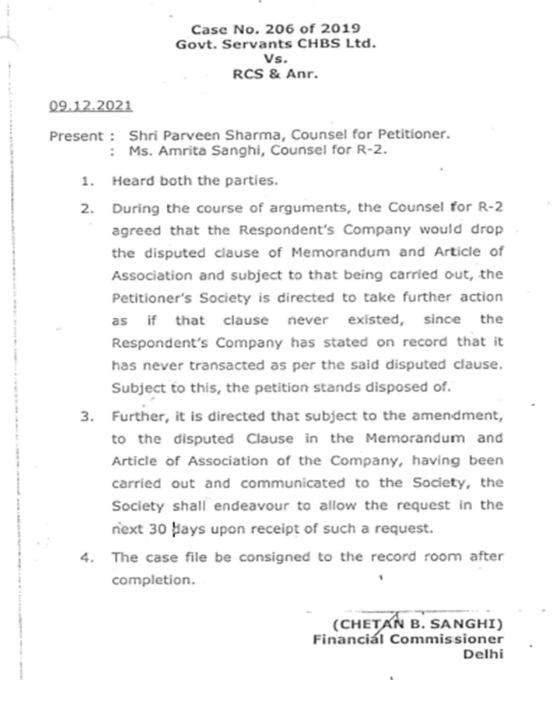
10. The review jurisdiction cannot be invoked for the purpose of explaining an order passed by the respondent no.1. He would claim that the view expressed by the respondent is in contravention to the judgment of the Apex Court in the matter of "Zoroastrain Cooperative Housing Society Limited & Ors. Vs. District Registrar Co-operative Societies and Ors." 2019 3 SCC 745.
11. According to him, the respondent no.1 has failed to consider that on the date of the application, the respondent no.3 was not qualified to be a member, a fact inferred from the impugned order dated 09th December, 2021, and in such an eventuality, the order impugned cannot be said to be sustainable.
12. The counsel for the petitioner has drawn support from the clause 5(1) of the byelaws, which reads thus:-
"5. Admission of members
(1) No person shall be admitted as a member of the Society under Bye-law 4(2) except the following:
(a) An individual competent to contract under (section 11 of the Indian Contract Act, 1872 (9 of 1872);
(b) an individual who is not a member of any other co-operative housing society in NCT of Delhi;
(c) an individual who owns a plot I floor I dwelling unit in Vasant Vihar or Shanti Niketan either by assignment or by inheritance. Provided the number of members in respect of a plot shall not exceed the number of dwelling units permissible for the specific size of the plot under the master plan of Delhi as may be inforce from time to time.
(d) the individual is a citizen of India, except in case of legal heir;
(e) the age of individual is more than 18 years, except in the case of minor heir of a deceased member;
(f) the individual does not own a residential house or a plot of land for construction of a residential house in any of the approved or un- approved colonies or other localities in the NCT of Delhi in his/her own name or in the name of his/her spouse or any of the dependent children either on lease-hold or free-hold."
13. Drawing support from the Rule 19 of the DCS Rules, 2007, it is his contention that the society is armed with the powers to deal with the requests for the grant of membership.
14. It is further claimed that even Section 22 of the DCS Act supports the case of the petitioner.
15. As against above, the learned counsel for the respondents have opposed the prayer. According to the counsel for the respondents the order of the transfer of the membership passed by respondent no.2 is valid in law which has given the cause for the petitioner to take recourse to the revisional jurisdiction.
16. It is their contention that the respondent no.1 has passed a workable order, thereby accepting the contention of the petitioner, that respondent no.3-Company would drop the disputed clause from the Memorandum of Association and Article of Association and consequent thereupon, the petitioner has to take further action as if the clause never existed.
17. The aforesaid order was based on the fact that respondent no.3 had never transacted as per the said disputed clause.
18. The petitioner-society was directed to make every endeavor to allow the request.
19. According to them, it is only an invocation of review jurisdiction by the petitioner; the authority passed a detailed order thereby considering the legal submissions.
20. The counsel for the respondent no.3 has claimed that the order impugned are in conformity with Section 22 of the DCS Act.
21. It is further claimed that, in case, if the byelaws are permitted to prevail, same will negate the statutory mandate under Sub-section (2) of Section 11 of the DCS Act.
22. It was his further contention that in the hierarchy, the Act shall always prevail over the rule and byelaws, whereas rules shall prevail over the byelaws and not over the Act. Support is drawn from the judgment in the matter of "State of U.P. and Ors. Vs. C.O.D. Chheoki Employees' Co-op. Society Ltd. and Ors." (1997) 3 SCC 681.
23. According to the counsel for the respondent, the judgment in the matter of "Zoroastrain Cooperative Housing Society Limited &Ors". (supra) will not have the applicability to the factual matrix of the present case, as the Apex Court in the said case was confined to the membership to the extent of a particular community, which is not similar to the facts of the case in hand.
24. Similarly, it is claimed that two authorities have concurrently held against the petitioner and that being so, no interference in extra-ordinary jurisdiction is called for, accordingly, the dismissal of the present petition is sought.
25. Similarly, respondent no.3 has drawn support from the provision of Section 11, Section 20 and Rule 20 of the Act and Rules respectively.
26. The said provisions read thus:
RELEVANT PROVISIONS:
* Section 11 of DCS Act
11. Bye-laws of co-operative societies.
(1) Every co-operative society may make its bye-laws consistent with the provisions of this Act and the rules made thereunder.
(2) In particular and without prejudice to the generality of the foregoing power, such bye-laws may provide for all or any of the following matters, namely:-
(a) The name, address and area of operation of the society;
(b) the objects of the society:
(c) the services to be provided to its members;
(d) the eligibility for obtaining membership;
(e) the procedure for obtaining membership;
.
.
.
* Section 22 of DCS Act
22. Persons who may become members.
(1) No person shall be admitted as member of a co-operative society except the following, namely -
(a) an individual competent to contract under section 11 of the Indian Contract Act, 1872 (9 of 1872):
(b) any other co-operative society;
(c) the Government;
(d) a firm, a joint stock company, or any other body corporate constituted under any law; and
(e) such class or classes of persons or association of persons as may be notified by the Government in this behalf:
Provided that the provisions of clause (a) shall not apply to an individual seeking admission to a co-operative society exclusively formed for the benefit of students of a school or college:
Provided further that no individual shall be eligible for admission as a member of any financing bank or federal co- operative society except as provided in clause (m) of section (2) Notwithstanding anything contained in sub-section (1), the Government may, having regard to the fact that the interest of any person or class of persons conflicts or is likely to conflict with the objects of any co-operative society or class of co-operative societies by general or special order. published in the official Gazette, declare that any person or class of persons engaged in or carrying on any profession, business or employment shall be disqualified from being admitted, or for continuing as member or shall be eligible for membership only to a limited extent of any specified co- operative society or class of co-operative societies, so long as such person is or such persons are engaged in or carrying on that profession, business or employment, as the case may be.
* Rule 20 of the DCS Rules
20.Disqualification of membership
(1) No person shall be eligible for admission as a member of a co-operative society if he:-
(a) has applied to be adjudicated an insolvent or is an undischarged insolvent, Or
(b) has been sentenced for any offence other than an offence of a political character or an offence not involving moral turpitude and dishonesty and a period of five years has not elapsed from the date of expiry of the sentence, Or
(c) In the case of membership of a co-operative housing society,
(i) owns a residential house or a plot of land for construction of residential house in any of the approved or un-approved colonies or other localities in the National Capital Territory of Delhi, in his own name or in the name of his spouse or any of dependent children, on lease hold or free-hold basis or on power of attorney or on agreement for sale:
Provided that above clause shall not be applicable,
(a) in case of co-sharers of property whose share is less than 66.72 sq. metres of land; or if the residential property devolves on him by way of inheritance,
(b) in case of a person who has acquired property on power of attorney or through agreement for sale and on conversion of the property from leasehold to freehold on execution of conveyance it, if such person applies for the transfer of membership housing society concerned,
(ii) deals in purchase or sale of immovable properties either as principal or as agent in the National Capital Territory of Delhi; or
(iii) his spouse or any of his dependent children is a member of any other co-operative housing society."
27. According to respondent no.3, the provision of the Section 22 shall prevail over the rules and the byelaws and that being so, the order of respondent no.1 shall prevail.
28. Thus, the dismissal of the present petition is sought.
ANALYSIS
29. We have considered the rival claims.
30. It is not in dispute that respondent no.2, in exercise of appellate jurisdiction, has directed transfer of membership in favour of the respondent no.3.
31. That the predecessor-in-title of respondent no.3, was a member of the petitioner-society is borne out of the record and is an admitted fact.
32. However, just because the respondent no.3, has purchased the property vide a registered deed, that by itself will not transfer the right and interest of membership in the petitioner-Society in favour of respondent no.3.
33. Membership of a cooperative society, in our opinion, cannot be said to be an attachment to the title to the property which was transferred to respondent no.3, as such does not appear to be the statutory mandate under Section 3 read with Section 8 of the Transfer of Property Act, 1882.
34. Perhaps, such position of law has prompted the respondent no.3 to apply for grant of membership in its favour with the petitioner.
35. It is not in dispute that the petitioner has rejected the request of respondent no.3 based on the byelaws.
36. Amongst other, the Memorandum of Association and Article of Association of respondent no.3 prescribes it to deal in the real estate/property. It is an express provision in the byelaws of the petitioner- society that a person dealing with property cannot be accepted or granted membership of the petitioner-society.
37. The fact remains, on the date of the application for membership by respondent no.3, or even on the date of the purchase of property, respondent no.3 was dealing with immovable property and impact of such clause in its Memorandum of Association and Article of Association, in view of byelaws, disentitled the respondent no.3 to seek membership of the petitioner-society.
38. Even if, the provisions of Section 22 will have the overriding effect over the byelaws, however, we are equally required to be sensitive to the sub-clause (d) of sub-section (2) of Section 11 of the DCS Act, wherein the power to frame eligibility conditions for obtaining membership is prescribed.
39. Similarly, Section 22 though contemplates that a body corporate may ask for the membership, however, a plain reading of the said provision only provides that a body corporate can be a member, but it is not provided that the byelaws can be bypassed for the said purpose.
40. Be that as it may, we are of the view that the respondent no.1 has committed an error in passing order dated 09th December, 2021, thereby directing the petitioner to make an endeavor to allow the request of the respondent no.3 to grant membership, provided respondent no.3 deletes the disputed clause from Memorandum of Association and Article of Association.
41. The aforesaid observation, in our opinion, was in view of the fact that on the date of application, there existed an embargo by virtue of existence of a clause in the Memorandum of Association and Article of Association which runs contrary to the byelaws, seeking membership of petitioner-society.
42. One can understand that respondent no.1 in such an eventuality, permitted the respondent no.3 to delete such disputed clause from its Memorandum of Association and Article of Association and then apply to the petitioner-society for grant of membership. However, such exercise in our opinion is at all not permissible in the wake of the scope of revisional or review jurisdiction. This legal position is strengthened by the judgment of the Supreme Court in the matter of "Malleeswari Vs. K. Suguna and Another (2025 SCC Online SC 1927)", which states under:
"17. Having noticed the distinction between the power of review and appellate power, we restate the power and scope of review jurisdiction.
Review grounds are summed up as follows:
17.1 The ground of discovery of new and important matter or evidence is a ground available if it is demonstrated that, despite the exercise of due diligence, this evidence was not within their knowledge or could not be produced by the party at the time, the original decree or order was passed.
17.2 Mistake or error apparent on the face of the record may be invoked if there is something more than a mere error, and it must be the one which is manifest on the face of the record. Such an error is a patent error and not a mere wrong decision. An error which has to be established by a long- drawn process of reasoning on points where there may conceivably be two opinions can hardly be said to be an error apparent on the face of the record.
17.3 Lastly, the phrase 'for any other sufficient reason' means a reason that is sufficient on grounds at least analogous to those specified in the other two categories."
43. The revision was, in fact, preferred by the petitioner and it was expected of the revisional authority to deal with it having regard to the provisions of Section 11 and 22 of the DCS Act and the byelaw no. 5 of the petitioner-society.
44. The impugned order dated 09th December, 2021 is not dealing with such issues. Rather it appears that the order was passed by respondent no.1 based on certain concessions made by respondent no.3 which in fact were not acceptable to the petitioner. Merely because respondent no.3 has made certain concession, such concessions in the pending proceedings are not binding on the petitioner and it was expected of respondent no.1 to deal with the contention of the parties in its entirety in revisional jurisdiction and not in the review jurisdiction.
45. Further, the review jurisdiction is always confined as to whether exists an error apparent on the face of the record, which warrants the order of which review is sought to be recalled or set-aside.
46. The error apparent on the face of the record is interpreted to mean that such error which can be traced without referring to the documents and record of the case.
47. A perusal of the order under review, which is impugned in the present petition, primarily speaks of the revisional authority and while exercising the powers of review for dismissing the review application, has re-written the judgment as if it is re-appreciating the entire contentions and the law. Such exercise is not permissible for the reviewing authority to substantiate it by supplementing the reasons.
48. That being so, we are of the view that the order of the revisional authority and the order of the reviewing authority which are impugned in the present petition, are not sustainable.
49. We deem it appropriate to quash and set-aside the impugned order 09th December, 2021, so also the order dated 12th January 2024 passed in exercise of review jurisdiction.
50. We permit the parties hereto, to appear before the revisional authority i.e. respondent no.1 on 27th April, 2026.
51. We request the revisional authority to make an endeavor to decide the revision petition within a period of six months from the date of appearance of the parties.
52. Such revision shall be decided without being influenced by the finding recorded hereinabove.
53. Pending applications, if any, also stands disposed of.
54. Judgment be uploaded on the website of this Court.

 |
This Product is Licensed to , |